
Construction is Underway on More Giants for Cruising
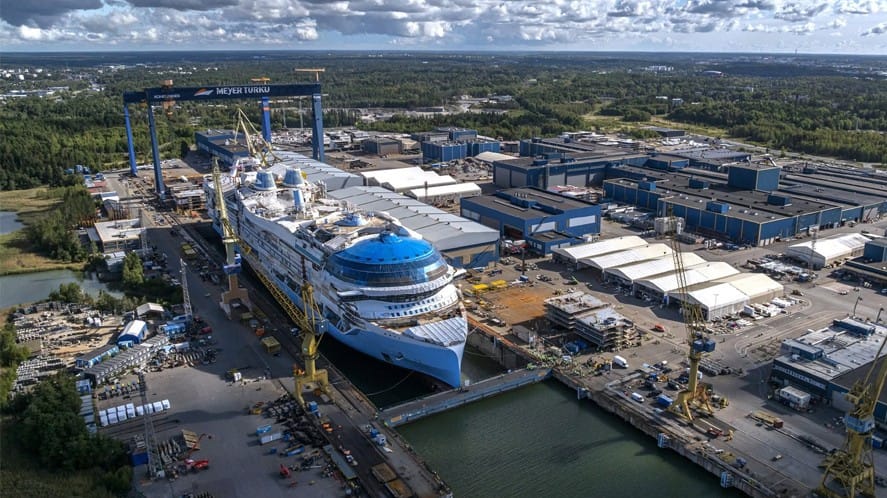
The pace of construction on the next generation of ultra-large cruise ships is gaining momentum. The ships are being floated out of their assembly docks and going on sea trials, while steel cutting and block assembly are already underway for even more of the giants.
For years, Royal Caribbean International’s two Oasis-class ships at 225,000 gross tons were the outliers, with none of the large, contemporary segment cruise lines willing to jump the 200,000 gross ton milestone. Imaginative concepts were presented, such as Kloster’s World City (proposed at 250,000 GT), but the lines continued to build ships in the 150,000 to 180,000 gross ton range.
Changing economics and the need to make space for even more amenities, however, are changing that. Currently, there are a dozen ships exceeding the 200,000 GT milestone, as MSC Cruises surpassed the mark and now Disney Cruise Line, which acquired and completed Genting Hong Kong’s partially built Global Dream. Collectively, these ships represent approximately 68,000 berths (roughly 3.8 million passengers annually), a relatively small fraction of the total industry, which the trade group Cruise Lines International Association (CLIA) projects is nearing 40 million passengers per year.
Fully a quarter of the new ships in the orderbooks, however, are set to exceed 200,000 gross tons, a total of 19 ships due to enter service in the next decade between November 2026 and 2037. Collectively, they represent more than 40 percent (4.3 million GT) of the total gross tonnage on order in the cruise industry, and more than 105,000 berths, or nearly half the capacity on order.
Yet, while the ships are coming in classes, Royal’s Oasis and Icon, MSC’s World, Carnival’s Ace, and Norwegian's so far unnamed class, the lines are working to differentiate the ships. They are learning from the designs and continuing to add new amenities, giving the giants individual personalities.
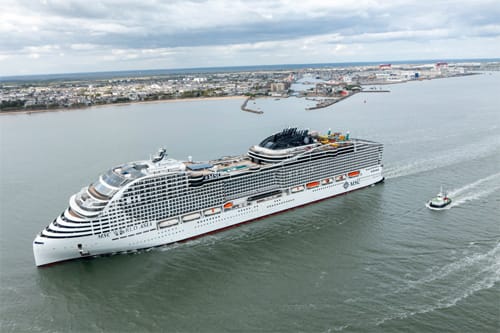
MSC's third World Class, MSC World Asia, departing the shipyard for trials (Chantiers de l’Atlantique and Askopia)
MSC’s World Class
First in the schedule is MSC’s third World Class cruise ship, MSC World Asia. She will be the 24th cruise ship for the brand and the third in the World Class, but they are promising some unique elements. MSC World Asia completed her second series of sea trials in mid-September after having gone to sea for the first time in July. Being built in France at Chantiers de l’Atlantique, they report the ship’s engines, maneuverability, fuel efficiency, safety systems, speed, and stopping distances were all tested.
Delivery of MSC World Asia is scheduled for November 25, and her first revenue cruise is December 4. The ship, which is approximately 216,638 GT, will accommodate over 6,700 passengers and 2,100 crew and feature more than 40 bars, lounges, and restaurants. Unique attractions will include the longest dry slide at sea, décor with flair from Asia including a 29-foot-wide dragon suspended 32 feet above the World Promenade, new dining experiences, expanded wellness and spa offerings, new shopping venues, and even the largest Venchi chocolate experience at sea.
MSC Cruises is not stopping there. MSC World Atlantic is already well into its assembly and due to enter service in late 2027. She was floated from the building dock on September 26. The company already had two more giants on order, and in November 2025 announced a further €3.5 billion investment, confirming orders for numbers seven and eight of the World Class due in 2030 and 2031.
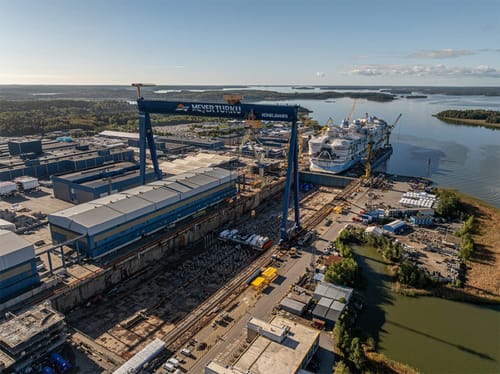
Blocks for the fifth Icon class ship are in the assembly dock (Meyer Turku)
Royal Caribbean’s Icon Class
In Finland, Meyer Turku also marked milestones in its construction program for Royal Caribbean International’s giants. The fourth ship of the class, Hero of the Seas, was floated and moved forward from the assembly dock on September 4. Meyer Turku highlights that it took 90 million gallons of water to fill the dry dock and move the 248,663 gross ton ship. Already visible in the background were the first blocks for Icon #5, and Meyer Turku reported on September 14 that the first steel block was now in place in the dry dock and assembly was underway on the ship due to delivery in 2028.
Royal Caribbean boasts of the changes for Hero of the Seas, including eight neighborhoods with the most pools at sea (nine distinct pools), a record-breaking 28 dining venues and cooking classes, new family raft slides, new accommodations for multigenerational families, and more. Like MSC, Royal Caribbean is not stopping there, for in addition to Icon #5, it has Icon #6 (due in 2029) and Icon #7 (due in 2030) on the books and Oasis #7, which is due in 2028.
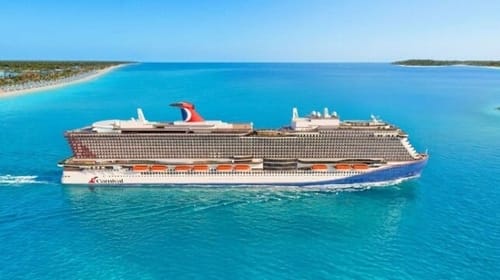
Rendering of Carnival Destiny, for which steel cutting began in July (Carnival Cruise Line)
Carnival’s Ace Class
A few weeks earlier, in July, Fincantieri in Italy started cutting steel for the first of Carnival Cruise Line’s first 200,000-plus gross ton ultra-large cruise ships. Known as Project Ace, steel cutting started on July 10 in Monfalcone, Italy, for the first ship, which is aptly named Carnival Destiny, celebrating the first cruise ship to exceed 100,000 gross tons. The new Carnival Destiny will exceed 220,000 tons and accommodate 6,160 passengers (over 8,000 passengers at full capacity). She is scheduled for delivery in the summer of 2029, followed by sister ships in 2031 and 2033.
Details are scarce right now, but Carnival Cruise Line calls her a “bold evolution in how guests engage on board.” More than 70 percent of its venues and attractions will be new concepts for Carnival, ranging from dining to bars and lounges, immersive entertainment, and outdoor spaces. Carnival Destiny, they said, will become the most outward-facing megaship, with an unprecedented number of balcony cabins and more than 4.5 acres of glass.

that matters most
Get the latest maritime news delivered to your inbox daily.
Rounding out the ultra-large cruise ships on the books are Norwegian Cruise Line’s orders for five ships simply referred to currently as “New Class,” also being built at Fincantieri. The ships are expected to be approximately 227,000 gross tons with accommodations for 5,000 passengers. The first is scheduled for 2030, then every other year until 2036, and the last in 2037.
For now, that’s the plan for the ultra-large generation of cruise ships. Earlier reports had indicated that MSC Cruises was discussing the possibility with Meyer Turku of approximately 260,000 to 270,000 gross ton ships that would be nearly 1,200 feet (365 meters) in length. While that project has not advanced, it seems certain that more ultra-large cruise ships will emerge in the future.
