
Despite Threats, For Now The Houthis Are Standing Aside
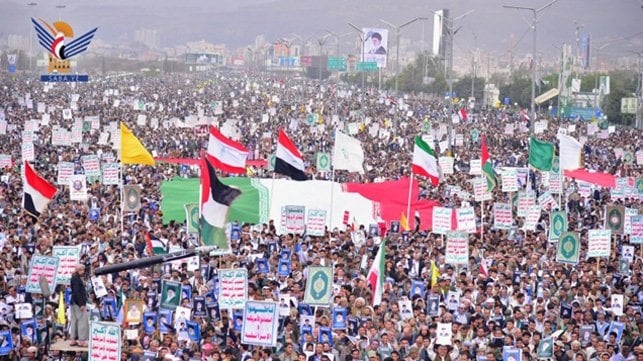
A huge Day of Al Furqan demonstration in Sana’a on March 5, in support of Iran and Lebanon’s Hezbollah, was mirrored by smaller demonstrations in other Houthi-controlled areas, and supported by a speech broadcast on state television by Houthi leader Abdul-Malik al-Houthi. The crowds reportedly demanded military escalation and confrontation, echoing some reports earlier last week for a resumption of Houthi attacks on shipping in the Red Sea and Gulf of Aden.
Nonetheless, while going along with the popular sentiment in his speech on television, Abdul-Malik al-Houthi subtly sent out a diametrically different message by pointedly not saying that the Houthis were about to launch attacks, while reserving the right to do so.
It is of some significance that at probably their greatest moment of crisis, Iran’s IRGC-dominated leadership has not been able to generate practical support from the Houthis, when apparently they have been able to mobilize action from both Hezbollah in Lebanon and pro-Iranian militias in Iraq. Some commentators have suggested that the Iranians have asked the Houthis to hold off for the moment, for a difficult-to-discern purpose. But really, this can only be interpreted as a calculated decision on the part of Abdul-Malik al-Houthi, because it clashes so diametrically with established Houthi ideology. Tellingly, the grossly misnamed Humanitarian Operations Coordination Center has not yet updated its website threat warnings, the last of which dates from September 30, 2025.
The most charitable explanation for the Houthis' inaction is that they fear that the Iranians are now a lost cause, and understand Sun Tzu’s dictum that a war isn’t worth fighting unless it can be won. Or simply, the Houthis suffered so much damage to their leadership cadre and military capability in the American and Israeli attacks last August that perhaps they are afraid of provoking another round of such devastating punishment.
This is not for lack of targets. A plot of ship movements in the sea areas at risk from further Houthi attacks on March 7 showed plenty of vessels transiting the area using the Maritime Security Transit Corridor (MSTC),
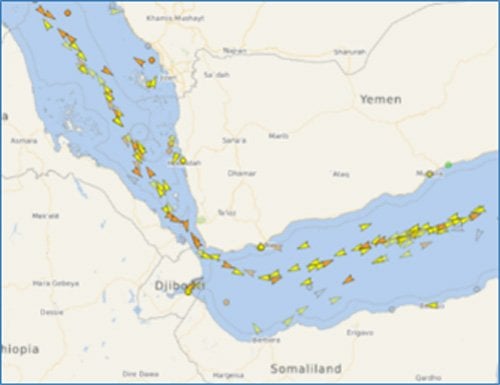
Southern Red Sea and Gulf of Aden tanker and cargo ship movements on March 7 (VesselFinder)

that matters most
Get the latest maritime news delivered to your inbox daily.
This current scenario revives consideration of an old question: are the Houthis independent, or are they under the control of the Iranians? The Houthis have had generous technical, munitions, and financial support from Iran. But Houthi representatives in Muscat have always claimed that despite this support and the integration of senior IRGC staff within senior decision-making bodies such as the Jihad Council, the Houthis remain autonomous. Moreover, since independence and before, tribal Yemenis have always displayed a particular propensity for switching allegiances as circumstances (or the tide of battle) change. If a timely reminder were needed that the Houthis would be well advised to sit out this particular phase of the long battle against Islamic Revolutionary Iran, the expanding American order of battle arriving in theatre is probably salient. But it may be a warning that is ignored, and if anything, Abdul-Malik al-Houthi’s recent speech was a warning of this.