
Criminal Charges Revealed for Chief Engineer of Containership Dali
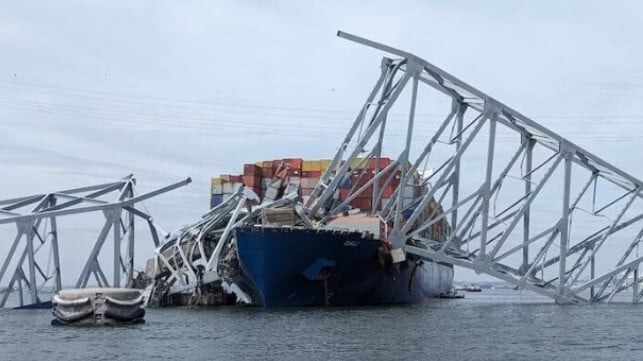
U.S. attorneys revealed in a court filing on Monday afternoon in Maryland that criminal charges have been brought against the chief engineer of the containership Dali, making him the first officer from the ship to face charges. The charges, however, only stem from a failure to notify the U.S. Coast Guard about dangerous conditions aboard the vessel, and the federal attorneys revealed they have also entered into a deferred prosecution agreement.
Karthikeyan Deenadayalan, reported by the media to be age 46, had been serving as chief engineer aboard the Dali since January 2024. The filing reveals a single count of violating the Port & Waterways Safety Act passed by the U.S. Congress in 1972 that requires immediate notification to the U.S. Coast Guard “whenever there is a hazardous condition, either aboard a vessel or caused by the vessel or its operation.”
It is alleged that the chief engineer “knowingly and willfully failed” to notify the USCG about conditions aboard the Dali when it arrived in Baltimore. It cites the fact that redundant supply and booster pumps for generators 3 and 4 were not being used and that a non-redundant flushing pump was being used in their place. The indictment charges that the first blackout on the Dali on March 26, 2024, was likely caused by a loose wire and that the second blackout, which was the cause of the fatal allision with the Francis Scott Key Bridge, occurred because the Dali relied on a non-redundant flushing pump to supply fuel to two of the ship’s four generators. This mirrors the assertions the U.S. is making in the criminal indictment revealed in May against the operators, Synergy Marine and one of its technical superintendents.
A hearing was scheduled for Tuesday, June 16, to review a deferred prosecution agreement that has been reached with the chief engineer. The U.S. did not detail the conditions of the agreement, but it is speculated that the chief engineer agreed to plead guilty and that it is possibly contingent on his testimony in the criminal case against the operator of the vessel.
The chief engineer is one of several senior officers and crewmembers who have remained in the United States since the incident that destroyed the Key Bridge in Baltimore in March 2024. Each of the individuals, however, invoked their rights against self-incrimination during the discovery phase of the civil trial. The hearing in Deenadayalan’s criminal case has been assigned to Judge James Bredar, a senior judge in the court who is also presiding over the civil trial.
U.S. attorneys in separate filings are proposing an October 2027 trial date in the criminal case against Synergy Marine and its technical supervisor. They also said that they are asking the court to issue trial subpoenas for several witnesses. Under federal law, the witnesses can be compelled to testify.
It is the latest step in the entailed legal filings against Grace Ocean as the vessel’s owner and Synergy Marine. In a separate filing also with Judge Bredar, the two companies made a claim to dismiss the remaining civil claims. About a dozen claims remain in the civil case, including the City and County of Baltimore, which claims economic loss for the destruction of the bridge, longshoremen who claim a loss of income while the port was closed and recovered, and various local businesses that claim economic loss of business.
The companies have settled the claims from the six families of the roadworkers who were killed, and with the survivors from the road crew. They have also settled with Maryland for the loss of the bridge and the federal government for the costs of the salvage and recovery efforts. More than 30 of the 50 claims, including cargo claims, were settled, while a few claims were also dismissed.
The companies are citing a 1927 U.S. Supreme Court ruling saying the remaining claims are not valid. The Supreme Court ruled in a suit against Robins Dry Dock & Repair Company that claimants had to have a proprietary interest in the property that was damaged or destroyed to seek recoveries. The charterer of a vessel that was damaged during a drydocking had sued Robins but was denied its claim as it did not have a proprietary interest in the damaged vessel.

that matters most
Get the latest maritime news delivered to your inbox daily.
Lawyers are arguing that the remaining claimants had no proprietary interest in the Key Bridge. Baltimore is arguing that it was the “intended beneficiary” of the bridge since it was built and as such entitled to recoveries for its economic losses.
Separately, in a U.S. District Court in Pennsylvania, another case has been filed by Grace Ocean against HD Hyundai as the builders of the containership. The companies are claiming manufacturing defects, while the shipyard highlights that the ship had been in service for more than a decade and they had no role in its maintenance during that time. A hearing over jurisdiction is scheduled for July in this case.