
Construction Order Placed for First Autonomous, Wind-Powered Cargo Ship
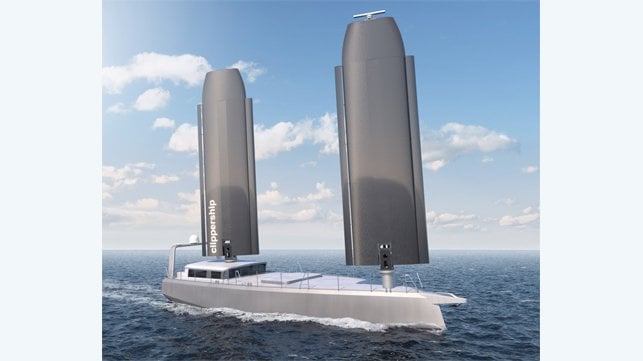
A California-based startup called Clippership, working with a team of established leaders in the maritime community, reports it has completed designs classed by RINA for its first vessel, a wind-powered cargo ship designed for autonomous operations. The first vessel is seen as a demonstration of the company’s unique concept targeting small shippers.
Naval architecture for the new vessel was carried out by Dykstra Naval Architects, renowned for innovative sailing vessels, while American naval architecture and marine engineering firm Glosten completed the vessel’s structural engineering. Clippership in developing the autonomy software and rigid sail/wing design in-house. RINA is the class society that approved the designs.
Having successfully completed the designs, Clippership has now entered into a construction contract with KM Yachtbuilders in the Netherlands, a yard known for rugged, innovative expedition vessels. The first ship, a 24-meter (79-foot) design, they report, will be launched in late 2026 and sail under the flag of Malta.
The company points out that the vessel is specifically designed for small shippers and will provide advantages over attempting to move small cargoes on larger containerships and the costs of ground transportation, or the costs of air freight. The vessel will have a capacity for 75 Euro-pallets with a climate-controlled cargo hold. They report the design is optimized for point-to-point transportation.
The ship will have two foldable rigid wings for primary wind propulsion. The wings will be made of a carbon composite, which the company says will make the wings more than twice as powerful as modern fabric sails. Further, the folding mechanism will permit the sails to be stowed flat on deck during adverse weather conditions or in port.
Key to the concept are lower operating costs. To achieve that, the vessel is designed for open-ocean autonomy. Initially, they anticipate a supervisory crew on board, but the ship will function through a series of systems. The ship will use real-time environmental inputs to dynamically manage course selection, wing trim, and steering control, as well as collision avoidance with other ships and stationary objects. Integrated systems include high-resolution marine radar; video and forward-looking infrared (FLIR) cameras; satellite-based remote weather sensing; and constant sharing of automatic identification system (AIS) data with other craft and shore stations.

that matters most
Get the latest maritime news delivered to your inbox daily.
Clippership, which describes itself as a maritime robotics company whose mission is to build a new and better way of transporting cargo across oceans and waterways, has ambitious plans. They report that the first demonstration ship will gather data to design improvements that will deliver even better performance. They look to use the information to advance the designs for the vessels and plan to evolve to fully uncrewed voyages with remotely monitored autonomy as the platform matures and MASS regulations are adopted globally.
The first ship will sail trans-Atlantic and to the Caribbean and South America. The company’s future plans call for a 48-meter (158-foot) vessel that will have a capacity for 400 pallets and automated pallet handling.