
China Follows SpaceX's Lead With Reusable-Booster Landing Barge
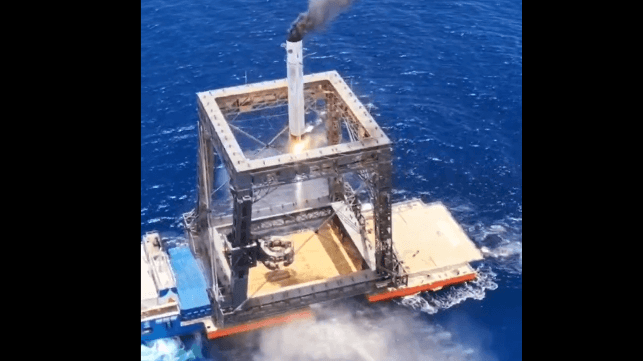
China Academy of Launch Vehicle Technology (CALT) has passed a key milestone towards cheap, plentiful orbital launch services: it can now do at-sea retrieval for used booster rockets.
On July 10, a Long March 10B rocket took off from a launch site at Wenchang, the first time that this kerosene/liquid oxygen-fueled rocket design has been flown. It placed its payload into orbit, and its first-stage booster returned for a successful landing - on a barge.
Like American rocket companies SpaceX and Blue Origin before it, the Beijing-based state aerospace giant China Academy of Launch Vehicle Technology (CALT) has developed a vessel platform to provide a landing pad at sea for its reusable rockets. The underlying concept is the same, but CALT's solution is different. SpaceX uses a robotic "grabber" to hold the landed rocket securely after touchdown. Blue Origin uses a comparable approach with multiple robotic support stands. CALT's barge design has a tall, fixed stand in the middle of the deck, which is fitted with a set of four robotically-controlled crosswires at the top. The crosswires engage the structure of the rocket as it descends, catching it and holding it in place.
For the first time, China has successfully landed an orbital reusable booster at sea. pic.twitter.com/GCmAuu9a2j
— OSINTtechnical (@Osinttechnical) July 10, 2026
A sea-based landing system is key to the economics of modern launch services. Until recently, booster rockets were discarded with every launch, so the full capital cost of the rocket was rolled into the price for each payload. SpaceX changed that with its Falcon 9 reusable rocket series, but it was not easy: it had several early failures before its first successful at-sea landing in 2016. Some of its individual first stage boosters have flown as many as three dozen times, and SpaceX is conducting up to 150 launches every year.

that matters most
Get the latest maritime news delivered to your inbox daily.
CALT's take on the reusable booster is the first to achieve a successful landing on the first try, and the first developed outside of the United States. However, it has been a long march to get to success. Chinese researchers have been working on reusable, liquid-fueled boosters since the 2010s, but Long March 10B is the first to demonstrate a working capability to land.
Reusable booster technology is expected to supercharge China's commercial space sector, and after news broke of the successful landing, investors quickly bid up stocks for satellite firms like China Spacesat and China Satellite Communications. Both hit China's regulatory limit for share price increases, restricted to 10% per day.
