
Alphaliner: Economic Pressures to Push Carriers to 27,500 Gigamax Boxships
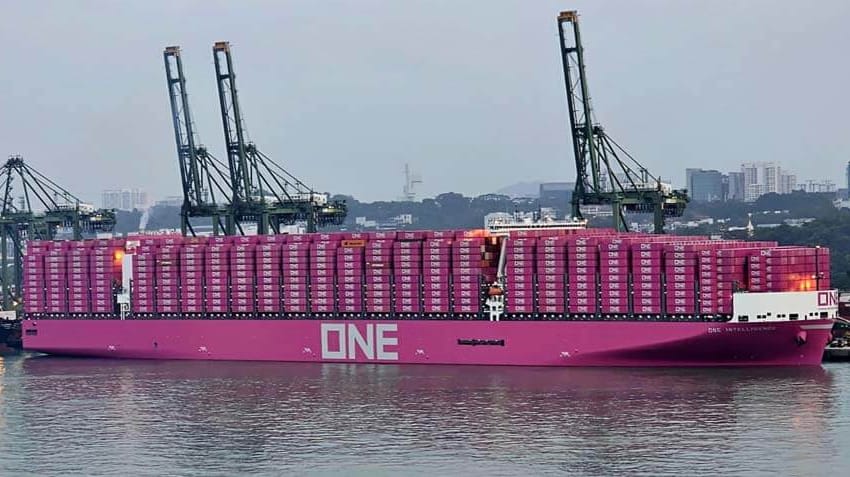
Do you want to supersize that containership may soon be the question shipbuilders and owners are contemplating, according to the consultants at Alphaliner. While the industry has plateaued at ultra-large container vessels, Alphaliner sees the elements that could easily lead to a new, ever-bigger class of Gigamax container vessels.
The consultancy is dusting off hypothetical concepts it presented five years ago, saying that market factors may just make the timing right for the new, bigger ship. It foresees a time by 2030 when the world’s top carriers could “theoretically deploy at least one 'full set’ of next-generation containerships on the East-West mainlines.”
“Increased cost pressure might prompt some of the largest carriers to reconsider their fleet strategies,” writes Alphaliner. It predicts some of the carriers will “opt for a novel ship type that is slightly larger than the current capacity record holders.”
The industry has a strong history of moving through these size categories. It went to the 18,000 to 19,000 TEU vessel for economies of scale. The next jump was to 23,000 to 24,000 TEU, but according to Alphaliner, for about a decade now carriers have stuck with that level. The ships are about 400 meters (1,312 feet) in length and have a beam of 61 meters (201 feet). It fits through the Suez Canal, and ports are adapted to handle this size of vessel. Shipyards and naval architects have toyed with the available space, and by making small changes to loading patterns and systems, they have squeezed the capacity by at most a few hundred boxes. The largest official TEU rating now stands at just over 24,300 boxes.
Carriers have discussed bigger ships, but so far none has made the move. They said the 24,000 TEU load seems "about right" for the market and the operating factors.
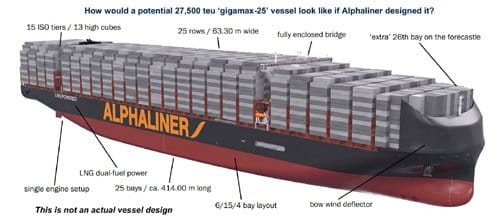
Alphaliner's hypothetical concept for a 425+ meter container vessel with 27,500 TEU capacity
The consultants at Alphaliner, however, are answering the question of why carriers might finally jump the current barrier.
“Especially in very long-haul East-West mainlines,” says Alphaliner, “factors like the increasing price of fuel and the introduction of carbon emissions taxes will give bigger ships a competitive edge in the long run.”
Its Giamax concept would be incremental, adding one hold or possibly two 40-foot bays beyond today’s 400-meter ships. They forecast a length of 425 meters or more, and that would give the ships a capacity of 27,500 TEU.
They believe that the ports that have already adapted to the 24,000 TEU ships would be able to absorb these slightly larger vessels. The applications would be limited, however, as many ports, such as in the United States, cannot handle even the 24,000 TEU ultra-large vessels.
Alphaliner is not the only one working on theories for the next generation of giants. China’s Shanghai Ship Research and Design Institute and projects looking at the future of nuclear-powered containerships have also shown the potential to leap the 24,000 TEU barrier.

that matters most
Get the latest maritime news delivered to your inbox daily.
The concept of going to bigger ships seems to fit with the trends in the industry. As the ships get more expensive to build and operate, more boxes will rebalance the economic equation and potentially help with the anticipated wave of older ship retirements that has long been predicted.
The container segment already has a record orderbook as carriers continue to order new ultra-large vessels. Alphaliner points out that over a relatively short period of time the industry’s capacity has soared from 23.2 million TEU to a current 34.1 million TEU. It is up 47 percent, and deliveries from the orderbook are likely to continue to drive capacity in the sector.
