
The Next Generation of Marine Propulsion
How ZF Is Helping Operators Navigate the Transition to Hybrid and Electric Power
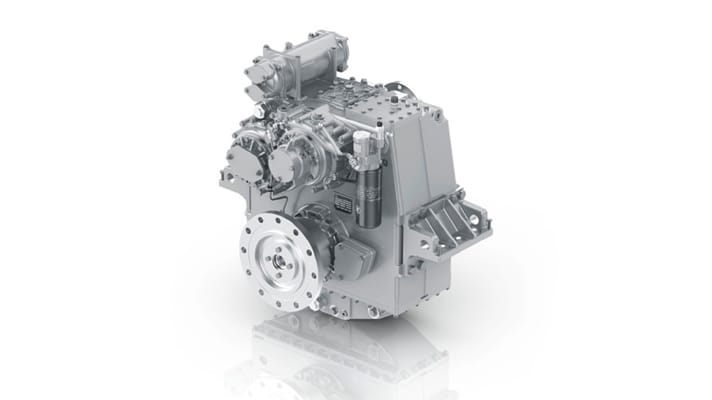
The maritime industry's transition toward lower-emission operations is no longer a future consideration—it's happening now.
Driven by stricter environmental regulations, rising fuel costs, sustainability initiatives, and the need for greater operational flexibility, commercial vessel owners are increasingly investing in hybrid and electric propulsion systems. While some vessels are well-suited for fully electric propulsion, others require hybrid solutions that balance emissions reductions with the range, reliability, and power of conventional diesel engines.
The challenge for operators isn't simply choosing electric over diesel. It's selecting a propulsion partner capable of delivering an integrated system that meets today's operational demands while providing a practical roadmap for tomorrow.
As a complete driveline supplier, ZF provides hybrid transmissions, electric motors, control systems, azimuth thrusters, fixed-pitch propellers, and shaftlines engineered to work together as a single propulsion solution that system integrators can use to easily update their full solutions, too. The result is a harmonized system that reduces integration complexity while helping vessel owners improve efficiency, lower emissions, and reduce operating costs.
The Case for Hybrid
Modern hybrid systems allow vessels to operate in multiple modes depending on the mission. A hybrid tug waiting on standby can minimize fuel consumption by operating at reduced engine loads. Hybrid ferries can maneuver quietly through populated waterfronts under electric power. Hybrid research vessels benefit from near-silent operation with significantly reduced vibration, improving both scientific data collection and onboard comfort. During acceleration or emergency maneuvers, electric motors can provide additional boost, while generator mode allows the propulsion system to produce onboard electrical power, improving overall fuel efficiency. Because the diesel engine spends more time offline during electric operation, maintenance intervals can also be extended, helping lower lifecycle costs.
Rather than offering a single electrification solution, ZF has developed a portfolio that allows vessel owners to choose the propulsion architecture best suited to their operational profile.
Serial Hybrid and Fully Electric Propulsion
For operators pursuing maximum emissions reductions, ZF's serial hybrid and fully electric propulsion solutions provide a flexible foundation.
The company's new ENC transmission family—available across the ZF 2000 through ZF 9000 series in straight, angle, and V-drive configurations—is optimized specifically for high-speed electric motors. Designed with exceptional power density, efficiency, and low noise and vibration characteristics, the transmissions allow naval architects to integrate electric propulsion without compromising the performance expected from commercial-duty vessels.
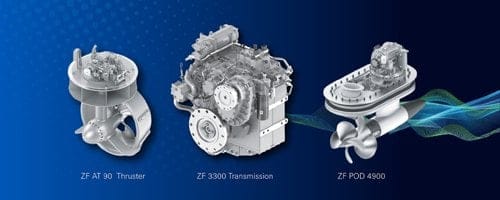
ZF has expanded those capabilities beyond conventional shaftline propulsion. Its POD propulsion systems with direct-drive electric motors combine efficient electric propulsion with outstanding maneuverability, while the company's thruster portfolio is available with direct electric motors across virtually every configuration, including deck-mounted, retractable, tunnel, counter-rotating, and well-mounted installations.
This broad portfolio enables operators to specify propulsion systems tailored to vessel type rather than adapting their operations to a limited technology offering.
Parallel Hybrid Solutions
For many commercial applications, parallel hybrid propulsion offers the ideal balance between proven diesel performance and the benefits of electrification.
ZF's hybrid transmission lineup includes Hybrid Module Transmissions with directly mounted Power-Take-In (PTI) electric motors for the ZF 3000 and ZF 5000 series, alongside PTI-equipped conventional transmissions. Available in straight, down-angle, and V-drive configurations, these solutions provide flexibility for both new vessel construction and repower projects.
Waterjet-powered vessels are equally well served through ZF's NRD PTI transmission line, while future development continues on POD propulsion and thrusters utilizing PTI-connected electric motors paired with diesel prime movers.
Among the portfolio's most innovative solutions is ZF's Hybrid Module. Unlike traditional hybrid installations that require a particular setup, the plug-and-play module integrates the electric motor into a common supporting frame. This significantly reduces installation space, simplifies maintenance, and enables existing vessel platforms to be retrofitted with hybrid propulsion more efficiently.
A New Generation of Azimuth Thrusters
Designed for demanding commercial applications such as tugs, towboats, and inland push vessels, the well-mounted Z-drive thruster series spans a power range from 100 kW to 2,500 kW while accommodating virtually any hull form. Every AT thruster model can be configured as part of either a hybrid or fully electric propulsion system, giving operators a clear pathway toward CLEANSHIP class notations and future emissions requirements.
In hybrid configurations, the AT series enables vessels to maneuver under electric power in ports and environmentally sensitive waterways, reducing fuel consumption and emissions while providing additional boost power when needed. The series also includes environmentally responsible design features. The newest model, the ZF AT 90, supports commercial vessels up to 2,651 horsepower while delivering competitive lead times and low lifecycle costs.
A Total Propulsion Partner
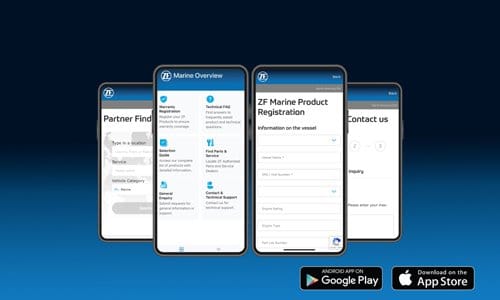
Rather than requiring shipbuilders to source transmissions, motors, controls, and propulsion equipment from multiple suppliers, ZF engineers these components to work together. This approach simplifies integration, reduces project risk, and ensures every component is optimized for the application. It also gives vessel owners access to a global engineering, service, and support network: ZF operates a 24/7 customer service line via 1-833-ZF-WRENCH, while the ZF Marine app also puts users in contact with parts service and its product catalog.
ZF also recently announced significant investments in North American manufacturing and distribution capabilities, including expanded production machinery and a new logistics center to open later this year. These investments are designed to improve manufacturing efficiency, increase parts availability, streamline logistics and reduce transmission lead times.
Technology Proven on the Water
From electric ferries and hybrid harbor tugs to commercial yachts and inland workboats, ZF propulsion systems demonstrate the operational, environmental and economic benefits of electrification across a diverse range of vessel types.
Those real-world success stories continue through Profiles from the Helm, ZF's ongoing series featuring captains, builders and operators who rely on ZF equipment every day. Their experiences demonstrate that while propulsion technology continues to evolve, reliability, efficiency and trusted partnerships remain at the heart of every successful voyage.
As the maritime industry charts its course toward lower-emission operations, ZF is helping customers navigate every stage with integrated propulsion systems, continued investment in manufacturing and customer support, and a portfolio that meets the needs of today's vessels while preparing them for the demands of tomorrow.
Discuss these marine propulsion systems with ZF during upcoming industry events, including SMM Hamburg, the Pacific Maritime Expo, the International WorkBoat Show, and others, or contact an expert.
This article is sponsored by ZF Marine.
The opinions expressed herein are the author's and not necessarily those of The Maritime Executive.
