


The U.S. Blockade of the Strait of Hormuz Begins
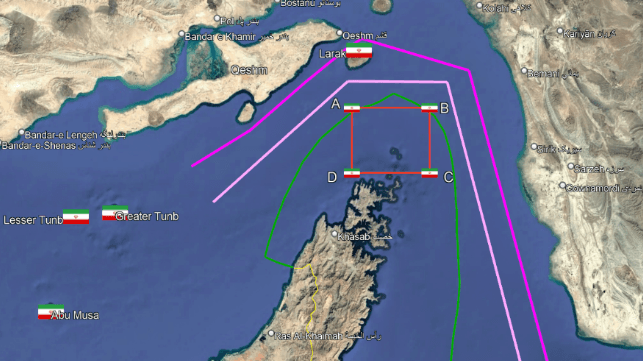
The U.S. blockade of the Strait of Hormuz took effect at 1800 hours local time in the Gulf (1000 hours Eastern) on Monday, April 13. More than 15 U.S. Navy warships are in place in the region to implement the naval cordon, officials told the Wall Street Journal.
The blockade is to be enforced “impartially against vessels of all nations entering or departing Iranian ports and coastal areas,” and covers ports and areas both within the Gulf and in the Gulf of Oman. Ships proceeding to or from non-Iranian ports will not be interdicted. This means that Omani domestic traffic will not be affected, nor will non-Iranian vessels that decide they now wish to risk moving to and from non-Iranian ports.
Mariners have been advised to contact U.S. naval forces on bridge-to-bridge channel 16 when operating in the Gulf of Oman and Strait of Hormuz approaches.
Clearly, U.S. naval forces undertaking the blockade could be subject to threats from Iranian forces in the form of drone or missile attack. With most surface combatants of the Iranian and IRGC navies already disabled, the surface threat is likely to come from fast attack craft and speed boats.
A capability to either interdict or respond to all such attacks will be an integral part of the CENTCOM plan. However, it does not appear as if the implementation of the blockade is to coincide with a general resumption of air warfare against Iran, although there is a risk of a resumption of wide-scale attacks should the U.S. response to a particular incident widen into more general conflict.
There is no particular need for U.S. intercept operations to be carried out within range of Iranian attack systems, and it would be safer, with less danger of escalation, for such operations to be carried out deeper into the Gulf of Oman and Arabian Sea. There is likely to be some plan to push oil confiscated or interdicted at sea back into the market, thereby maintaining supply without the Iranians benefiting financially.
Expected to proceed hand-in-hand with the blockade operation, but not necessarily immediately, will be the roll-out of a mine clearance operation in the Strait.
The Iranian response to the CENTCOM blockade is fairly predictable. Rather than attempting to respond to each and every incident at sea, for which they now lack sufficient long-range capability, the Iranians are likely to retaliate by widening their attacks on infrastructure targets in Gulf countries. On Monday, state news outlet IRIB warned that Iran would retaliate against the blockade with strikes on neighboring states' seaports, and that port access in the region would be "either for everyone or for no one."

that matters most
Get the latest maritime news delivered to your inbox daily.
The GCC countries will be expecting such attacks, which the more sanguine will regard as the price that must be paid for a reopening of the waterway on which their economies critically depend. Besides preparing for the Iranian counter-attack, Gulf states may be reaching the limits of the restraint they have so far exercised, and may well have plans of their own on how to respond to any increased Iranian aggression.
At least two sanctioned vessels with Iranian cargoes appeared ready to test the blockade late Monday. AIS data shows that the tankers Elpis and Rich Starry both transited the waterway and entered the northern end of the Gulf of Oman overnight; Elpis appeared to be paused at a position west of Jask as of Tuesday morning. Rich Starry is Chinese-owned and -operated, according to her Equasis record - a potential diplomatic complication for any interdiction operation. China is by far the largest buyer of Iranian oil, as well as the world's largest naval power by fleet size.
