


Norsepower Extends Wind Rotor Installations to Japanese Newbuild VLCCs
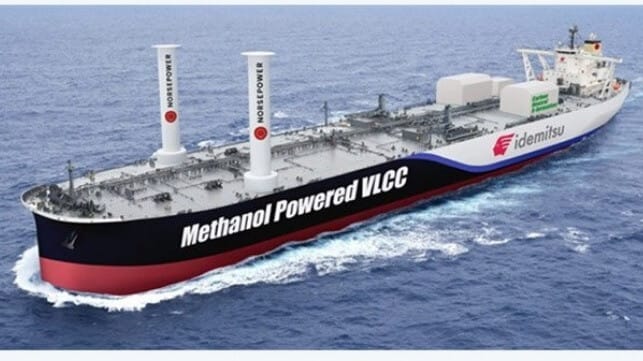
Wind-assisted propulsion continues to make advancements into more segments of the shipping industry, with Norsepower reporting it has signed its first contract for newbuild VLCCs and its first newbuilds in Japan. The company offers a modernized, data-driven evolution of the century-old Fletter rotor, a spinning cylinder that uses the Magnus Effect to create a propulsive force that lowers engine power and fuel consumption.
Idemitsu Tanker Co., Ltd., the shipping arm of Idemitsu Kosan, which reports it has one of the world's largest fleets of tankers, has been developing a next-generation design to increase efficiency and reduce emissions. The company has more than a dozen VLCCs under charter as well as additional managed ships. The concept incorporates efficiency for the vessels and prepares them for future low-carbon fuels such as methanol.
Norsepower reports that it signed the landmark deal the the tanker company for the installation of its wind-assisted propulsion technology. The vessels will be built by Japan Marine United Corporation (JMU) and Nihon Shipyard Co. Each will be delivered with two 35x5 meter (115x16.5 foot) explosion-proof Norsepower Rotor Sails. The first vessel is scheduled for delivery by the end of 2028.
“By equipping our new VLCCs with the Norsepower Rotor Sail™, we are not only investing in fuel savings and emission reductions but also taking a decisive step towards the decarbonisation of long-haul shipping,” said Idemitsu Tankers.
According to Norsepower, the project demonstrates how integrating the intelligent, data-driven rotor sails into purpose-designed vessels can deliver exceptional performance gains. Depending on wind patterns, routing, and vessel operations, the company reports Norsepower Rotor Sails typically reduce fuel use by 5–25 percent — and even higher when conditions are favorable.

that matters most
Get the latest maritime news delivered to your inbox daily.
The installation is supported by advanced digital control systems that optimize performance in real time. According to Norsepowe, it ensures the sails operate at peak efficiency in every condition. By reducing reliance on engines, the system cuts both fuel consumption and emissions.
With the maturity of wind propulsion, Norsepower had found strong interest in the tanker segment. It reports it has 22 units in operation in this segment, with its systems installed on tankers ranging from smaller chemical tankers, LCO? carriers, MR, LR, VLGC, and now, for the first time, on VLCCs.
