


Iranian Trader Boats are Still Crossing the Strait of Hormuz
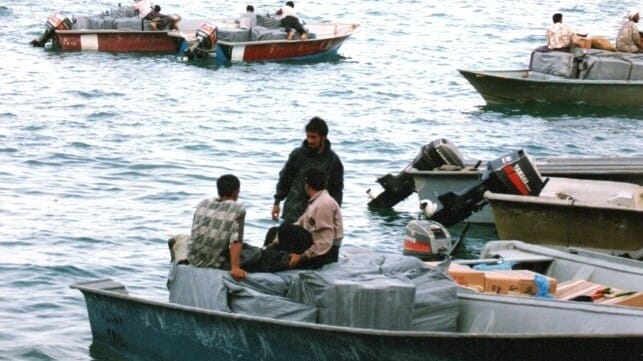
For decades, probably much longer, traders based in Iran have crossed the Strait of Hormuz, bringing goods to Oman’s Musandam governorate, bartering their cargos with merchants in Khasab, and then returning with cargoes of whatever is in short supply in Iran.
This long-established trade is legal as far as the Omani authorities are concerned, but illegal in Iran in the eyes of the Islamic Republic of Iran Customs Administration (IRICA). For this reason, the traders come across the Strait in the last hours of darkness to avoid Iranian customs patrols, with sometimes as many as 500 powerful speedboats racing into Khasab harbor though the mist shortly after dawn.
What the trader speedboats carry depends on the season: at the appropriate harvest time in Iran, it could be pistachio nuts, tomato puree or even live sheep. Carpets are a frequent cargo. Waiting for the trader speedboats are Khasab’s merchants, ready to barter the incoming goods for whatever commands a good price in Iran. This can include electrical appliances such as washing machines, or Western brand cigarettes, and potentially in recent times StarLink terminals. The trader boats wait for darkness, to better aid the avoidance of Iranian customs patrols, before setting off back home.
In this trading activity, the IRICA agents are not necessarily on the same side as the IRGC Navy, who would rather impose their own taxes on the trade, or purloin the occasional washing machine, rather than halt it. The IRGC Navy has however been known to infiltrate their own identical-looking craft in amongst the mass of trader speedboats, in order to conduct surveillance outside their own territorial waters. But the Omani authorities are adept at picking out the IRGC Navy infiltrators from amongst the mass of smuggler boats.
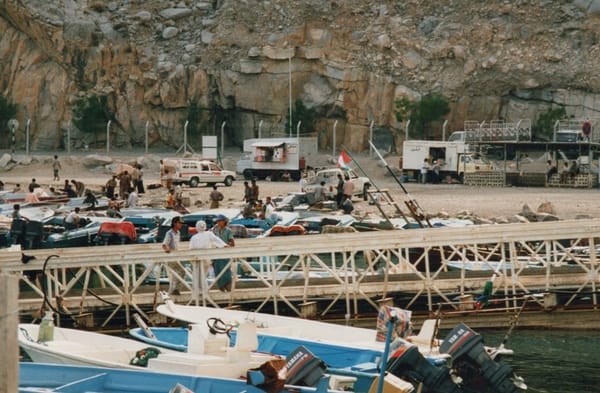
Trader speedboats in Khasab Harbor (©CJRC)
The volume of trade being carried is not large in financial terms, and very little of it will feature in Iranian trade statistics. Halting the trade will have no national-level economic impact whatsoever on the IRGC-dominated government of Iran, so could never be considered a lever. But the trade is economically-important locally in Oman’s Musandam and Iran’s Hormozgan Province.
Since the start of the war of February 28, this smuggler trade has barely faltered. Nor has it been affected by the US-imposed blockade imposed on Iranian ships and ports, the smuggler trading boats technically being neither ships nor using Iranian ports. This presents a problem. The smuggler boats, or craft looking very similar, can just as easily be used as platforms by the IRGC Navy for mounting attacks on shipping with small arms, rocket propelled grenades and limpet mines. The larger Iranian Maham-3 mines come with a wheeled dispenser enabling them to be launched from a minimally-modified speed boat: the smaller Maham-7 acoustic mine is even easier to lay.

that matters most
Get the latest maritime news delivered to your inbox daily.
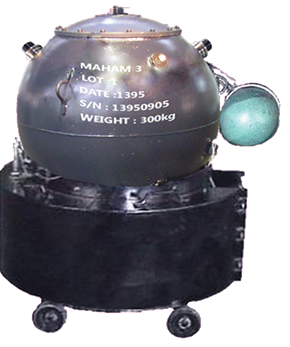 An Iranian Maham-3 moored mine sitting on its dispenser (IRGC Navy)
For the moment, the US blockade does not need to be close-in to the strait to be effective. High-value ships and cargos can be intercepted deep into the Arabian and Indian Oceans, and even further afield, applying a slow build-up of economic pressure on the Iranian regime. Closing down small-boat trader traffic will not increase or speed up this pressure. But if a serious mine-clearance operation is to be launched, and escorted convoys through the strait introduced, then the profusion of small speed boats crisscrossing the strait will need to be addressed.
