
United States Ambivalent to Russian Oil Sanctions
And commodity traders have noticed
Particularly in the United States, where the constitution was designed to incorporate checks and balances between the different parts of government, democracies do not always speak with one clear voice. So in examining what America’s attitude is towards the imposition and enforcement of oil sanctions, there may be discrepancies between what various arms of government are saying. For example, sanctions listings published as executive orders by the US Treasury’s OFAC, and even speeches from key figures in Congress, may not necessarily align with the current president’s intent, or his direction as commander-in-chief, particularly if measures were first introduced by a previous administration. For those in the maritime community affected by government policy, sometimes it is difficult to work out exactly what the policy is.
There is however a consistent direction of travel with regard to the prevailing US sanctions regime directed at Iranian oil exports. There has been some caution to stay within the fuzzy boundaries of UNCLOS and international law regarding interception of oil and ships on the high seas, and in well-known holding areas such as that off Malaysia’s east coast. Iran has built up stocks of oil held afloat over many years without facing obstacles. In recent months though, the United States has noticeably increased pressure on Iranian dark fleet activities, for example by more aggressive pursuit of brokers dealing in Iranian oil in jurisdictions such as the United Arab Emirates.
The blockade currently being imposed by Central Command on Iranian ships and ports is the ultimate frightener as far as Iran is concerned. Moreover, General Dan Caine, Chairman of the Joint Chiefs of Staff, has warned that Iranian-linked ships will be actively pursued globally, and not just in the Middle East, as part of an "Operation Economic Fury." This warning has sunk home, because Iran appears to be selling off stock held afloat or moving it to safer anchorages so as to reduce the potential risk of seizure.
The picture of enforcement against Russian dark fleet oil exports is however much less coherent.
When it comes to Russian oil heading to or from Venezuela and Cuba, US action has been consistent and robust since January 3 when Operation Absolute Resolve was launched to remove Venezuelan president Nicolás Maduro. The US Coast Guard has conducted long-range pursuits and boardings, and the naval squeeze on Cuba – barring a single humanitarian shipment allowed through on March 31 - has been particularly effective. The emphasis here is the effect on the buyers, not the seller.
But for Russian oil exports to China or India, where there are trade and tariff implications to interrupting exports and wider security considerations, the position is more ambivalent. No evident attempt has been made to interdict Russian oil supplies not piped but shipped to China, albeit both would be technically challenging. President Trump only recently increased the threatened level of tariffs to 50% on Russian oil imported by India.
In general, the current administration appears to be have little interest in enforcing sanctions against Russia, when their only purpose is to restrain Russia’s invasion of Ukraine. This stance reflects the administration’s general position as far as the conflict in Ukraine is concerned, also illustrated by pressure unsuccessfully applied on Ukraine to surrender additional territory to Russia, despite Russia’s recent front line reverses. In supporting context, Vice President Vance expressed pride at a Turning Point USA event on April 14 in having stopped all fresh US funding for Ukraine, with American arms for Ukraine now being paid for by Europe.
The US administration’s reluctance to pressure Russia over Ukraine through use of sanctions has been evident for some time, but even more so since the conflict with Iran began. The war has been used as cause for the temporary relaxation of sanctions on Russia, as a consequence of which Russia has been able to exploit inflated prices for its oil. It remains to be seen how long the sanctions relief will last, notwithstanding Russia’s support for Iran in the conflict. When the administration extended the relaxation for a further 30 days on April 17, citing the need to stabilize global oil prices, members of both parties in Congress raised objections.

that matters most
Get the latest maritime news delivered to your inbox daily.
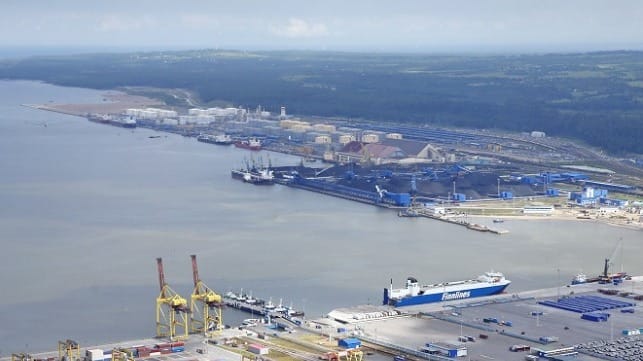
The divergent views on the need for anti-Russian sanctions enforcement has encouraged European nations to tighten their own hitherto limp sanctions, with an increased number of dark fleet interceptions at sea now being seen. It has also encouraged Ukraine to take direct action to reduce Russian exports by attacking tankers at sea and by mounting a sustained offensive against Russia’s western oil export terminals. Given the use of the ITAR regime to limit the supply of deep strike systems manufactured by all allied nations, it has also encouraged Ukraine to develop and manufacture missile systems independently. Ukraine's Flamingo FP-5 2,000-mile range cruise missiles are already in series production and are being used in repeated attacks on the terminals at Ust-Luga, Primorsk, Novorossiysk and Tuapse.
But bigger and better systems delivering kinetic enforcement, such as the 375-mile range ballistic missile being developed through the UK’s Project Nightfall, are to follow and will come into service in the following 12 months. The kinetic approach may prove more effective than sanctions in exerting fiscal pressure on Russia, with commodity brokers already sensing that compliance restrictions over US financing of deals are weakening.
The opinions expressed herein are the author's and not necessarily those of The Maritime Executive.
