
Thai Government Invests to Secure the Gulf of Thailand
The still relatively-new Thai government, reflecting a greater concern than previously over fractious relations with Cambodia, is further strengthening its defenses in areas where they might be particularly needed if conflict breaks out again, particularly in the Gulf of Thailand.
Conflict between the two countries was focused last summer on the disputed border in Sa Kaeo, Ubon Ratchathani and Si Sa Ket provinces on Thailand’s southeastern border. Cambodian villagers who had built homes and farmed on the Thai side of the border attempted to claim squatters’ rights, and to have the border adjusted. But there was a popular revolt at concessions being made to Cambodia in the dispute, which many believed was due to a corrupt relationship between previous Thai government figures in the Shinawatra family and the casino interests of the Cambodian Hun Sen ruling family. The Thai military insisted that a more robust line should be taken with Cambodia, which was a mandate supported in the election that followed. A peace agreement imposed in July last year was felt by many Thais to be too lenient to Cambodia, whose forces had been pushed back from the disputed areas.
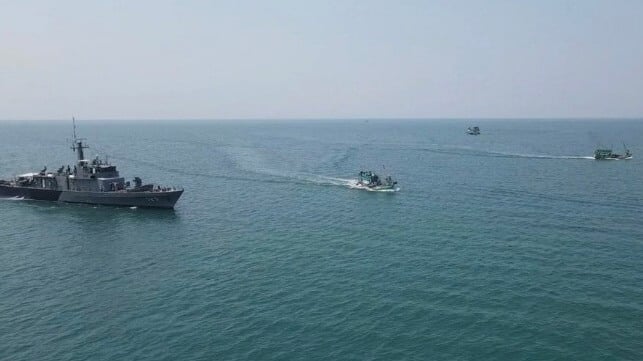
Trouble erupted once again in February this year when it was found that Cambodia had been laying mines on the Thai side of the border. But more troubling were clashes at sea, when on February 9 and 12, about 25 Cambodian fishing boats intruded approximately one nautical mile into Thai waters off the islands of Koh Kut and Koh Klang, at the southern end of the Khong Yai panhandle of Thai territory in Trat Province.
On both occasions the Krabi Class patrol boat HTMS Thepha (P525) intercepted the fishing boats and escorted the intruders out of Thai waters after warning shots were fired. The Thai Prime Minister General Anutin Charnvirakul in response suspended border negotiations in progress and concessions previously made relating to Thai territorial control of waters in the area, where Thailand had producing oil fields. The border with Cambodia remains closed.
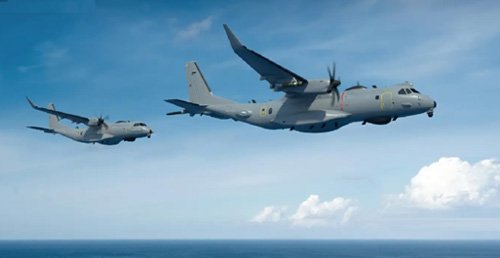
Soon to be in Royal Thai Navy colors, a pair of C-295 maritime surveillance aircraft (Airbus)
In the light of these clashes, and election promises to bolster Thailand’s defenses made by General Charnvirakul, Thailand has ordered two C295 maritime surveillance aircraft. The aircraft will be based at U-Tapao near Pattaya, adjacent to the disputed waters in the Gulf of Thailand, and will be operated by the Royal Thai Navy. Equipped with maritime search radar and an electro-optical/infra-red sensor suite, they should be able to build a single day and night onboard maritime intelligence picture. Thailand already has three C-295 transport variants operated by the Army, with two additional C-295s on order for the Air Force.

that matters most
Get the latest maritime news delivered to your inbox daily.
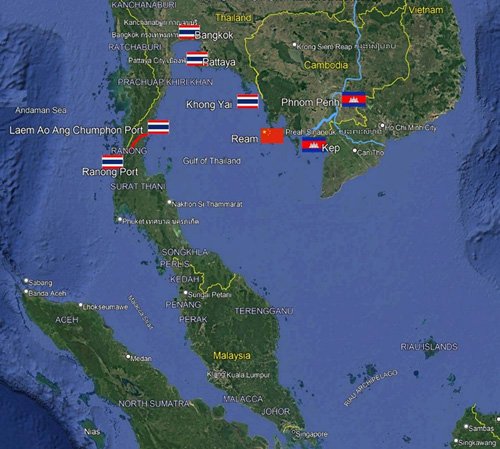
The Khong Yai area of Thai-Khmer coastal dispute, the Ranong to Chumphon Land Corridor (red) and the Funan Technical Canal shortcut from Kep to the Mekong River (blue) at Phnom Penh and thence China (Google Earth/CJRC)
Strengthening maritime and coastal surveillance is an important issue for Thailand. The realization that the Strait of Hormuz was vulnerable to closure has prompted a review of other maritime choke points, of which the Strait of Malacca is most prominent, and through which 30% of global maritime sea traffic passes. Singapore and Malaysia are opposed to imposing transit or pilotage fees on transits through the Strait, and after some hesitancy Indonesia now agrees with this line as well. But China is keen on reducing its dependency on the choke point and its potential exposure to closure. So it is a keen sponsor of the Funan Techno Canal links the Mekong from Phnom Penh to the Gulf of Thailand through a compliant Cambodia, avoiding a possibly belligerent Vietnam; it is scheduled to open in 2028. Thailand’s planned Southern Economic Corridor would then reduce the need to run the Strait of Malacca, and also save 650 nm and four days of sea passage. The Thai plan, still in the project definition phase, is to build road, rail and pipelines, all linked with two deep-water ports at Ranong and Chumphon, rather than a canal. Despite Singapore’s attractions as a highly efficient port, the corridor would have strong cost advantages, and could be transformative for Thailand: so it wants to make sure it dominates the Gulf of Thailand and the waters between Chumphon and Kep, notwithstanding the border dispute with Cambodia and the presence of the Chinese naval base at Ream.