
With Full Type Approval, SRC's Methanol Superstorage Moves Ahead
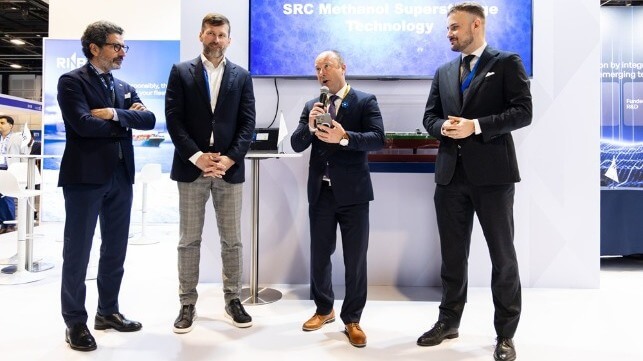
[SRC - Interview, Hannes Lilp, CEO]
With RINA granting full Type Approval to SRC Group’s Methanol Superstorage system, how significant is this milestone in accelerating methanol’s acceptance as a mainstream maritime fuel?
Securing RINA Type Approval is extremely significant as it demonstrates that the Methanol Superstorage solution has excellent structural integrity and has met RINA’s rigorous design review, risk assessment and testing procedures. Crucially, it is recognized as a safe storage system for methanol that can be installed on any vessel type, which provides assurance to shipowners that they are investing in validated, high-quality technology.
While both methanol and ethanol offer a clear pathway for shipping to move forward with decarbonization, they also have a much lower volumetric energy density than HFO, which means they need a larger onboard storage capacity for an equivalent energy output. Where conventional storage tanks feature inner and outer steel shells separated by a cofferdam of at least 600mm in width, Methanol Superstorage removes the space-related barrier to entry with a sandwich-structure which uses the SPS Technology’s Sandwich Plate System.
Type Approval of Methanol Superstorage confirms that a 25mm solid elastomer core, fully enclosed between two steel plates, is wholly fit for purpose. This will overcome reservations which may have deterred some shipowners from investigating methanol or ethanol – especially those running smaller vessels or ships with restricted onboard space.
Given methanol’s lower volumetric energy density compared to HFO, what is the potential for Methanol Superstorage to fundamentally change the practical feasibility of methanol adoption across different vessel types?
As verified by case studies, vessels incorporating Methanol Superstorage can store nearly twice the volume of methanol and ethanol compared to storage tanks with conventional cofferdam designs.
As a result, Methanol Superstorage can be applied to vessel types of all sizes, including small workboats and tugs, offshore support vessels, yachts, ferries, cruise ships, tankers and cargo vessels. Smaller vessels of under 50-70 meters in length with conventional storage tanks may not previously have been candidates for methanol: now, this green fuel option is no longer the preserve of larger, oceangoing ships.
The simpler tank design which goes hand in hand with the use of SPS Technology also removes the need for regular inspections and gas-freeing, extending the solution’s service life and saving man-hours.
From a shipowner’s perspective, how does the Methanol Superstorage system help remove technical, financial, and operational pain points associated with transitioning to methanol fuel, particularly in terms of retrofitting, bunkering frequency, and onboard space utilization?
The cofferdams which are a feature of conventional storage tank solutions need to be at least 600mm across to serve as a secondary safety barrier in the event of a leak, impact or a fire. An owner running a ship on methanol using such a solution must either accept a shorter operating range or more frequent bunkering. Methanol Superstorage overcomes this operational shortcoming using the compact SPS Technology’s Sandwich Plate System.
The fully bonded construction ensures excellent structural integrity, effectively distributes impact and pressure loads and provides a reliable containment barrier against leaks and emissions. Importantly, the system maintains safety standards equivalent to traditional cofferdam arrangements under IMO MSC.1/Circ.1621, while significantly increasing the volume available for methanol storage.
This 25mm solid polyurethane elastomer core also acts as a load-transferring, energy-absorbing and sealing layer. It creates an oxygen-free environment that prevents hidden corrosion and removes the need for the routine manual inspections typically required for conventional cofferdams.
How does the adoption of methanol as a marine fuel help shipowners align with the International Maritime Organization’s Net Zero emissions targets while maintaining compliance with evolving regulatory frameworks?
Methanol and ethanol enable shipowners to comply with IMO’s targets for decarbonization and net-zero emissions by virtually eliminating SOx and particulate matter emissions, while cutting NOx emissions by up to 80%. This can help vessels to achieve superior ratings under IMO’s Energy Efficiency Existing Ship Index (EEXI) and Carbon Intensity Indicator (CII) measures.
Methanol and ethanol are also relatively easy to bunker and store in their liquid state at ambient conditions compared with other gaseous alternatives. As a result, methanol and ethanol remove the need to retrofit vessels with scrubber technology, which can involve substantial cost and downtime, including rearrangement of pipework and onboard machinery spaces.
Proactively switching to a clean fuel like methanol demonstrates a serious commitment to sustainability, making fleets more attractive to investors who prioritize ESG performance. For example, it can enhance access to green financing options, including tailor-made sustainability-linked loans, on more competitive terms. Early adopters have successfully used methanol projects to tap into these funds, broadening their investor base. This will become increasingly important as the industry transitions from fossil methanol to renewable or ‘green’ methanol. Shipowners will have to demonstrate that GHG emissions have been reduced sufficiently throughout the entire fuel production cycle, in line with IMO’s carbon pricing rules.
Investment in alternative fuel-capable newbuildings in the first quarter of 2026 slipped 40% from the same period last year, largely due to delays in adopting IMO’s Net-Zero Framework in October 2025. Is this a missed opportunity for shipowners to develop their “green agenda”?
It is fair to say that investors seek certainty on the regulatory frameworks they operate within, in order that they can make the best choices on new and emerging technologies. Once a regulatory decision is made, they will also hope for it to remain in place unless new evidence or significant developments justify a revision. Lack of certainty undermines confidence.
Having said that, it is also fair to recognize that few can have expected the ‘green transition’ journey to net-zero to be entirely smooth, especially as it applies to a global industry like shipping. We are overhauling decades of reliance on conventional fuels, after all, by multiple buyers, sellers, consumers, shipbuilders and technology companies, supported by an existing global infrastructure and an installed base of ships. This is before we even consider the uneven readiness for market of the various alternative fuels to HFO on offer.
But it is also important not to mistake temporary setbacks or missed opportunities for failure. While the outcome of the October 2025 MEPC meeting was disappointing for those proposing a financial mechanism to support Net Zero Framework implementation, it remains true that the IMO’s 2023 greenhouse gas strategy to achieve net zero emissions by around 2050 was agreed by consensus.
Forward-looking shipowners with that horizon in mind recognize that preparing their fleets for decarbonization remains the prudent course. Together, energy efficient technology and operations, readiness for alternative fuels and strategies of mitigation for changing scenarios represent the mature response to the uncertain pace of change towards shipping’s net zero future.
The products and services herein described in this press release are not endorsed by The Maritime Executive.
