
NextFloat Project's Installation Site Secures EIA for Pilot Deployment
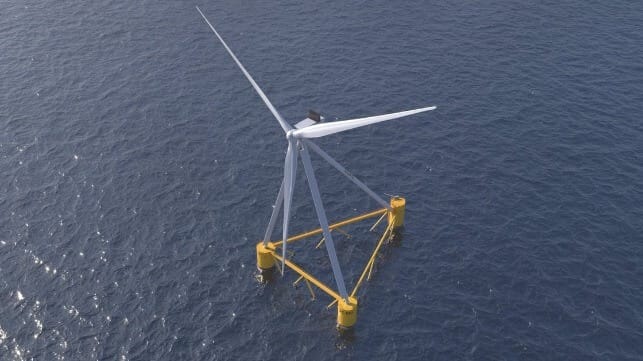
[By: X1 Wind]
The PlemCat test site, a dedicated infrastructure for developing pioneering and innovative floating offshore wind projects within the LEBA 1 commercial area in the Spanish Mediterranean Sea, has successfully obtained its Environmental Impact Assessment (EIA) approval. This critical regulatory milestone clears the path for the NextFloat Project, which involves the deployment of X1 Wind’s X100 8.5MW platform.
From a technical and regulatory perspective in Spain, obtaining a favorable EIA under the criteria of the Ministry for the Ecological Transition and the Demographic Challenge (MITECO) means passing the country's most rigorous environmental evaluation. This resolution, officially published in Spain's Boletín Oficial del Estado (BOE) on July 8th, guarantees that the PlemCat test site and its projects have undergone exhaustive planning and certifies their full compatibility with environmental protection, the preservation of the marine environment, and local biodiversity. The EIA is an indispensable prerequisite for materializing any offshore wind installation in Spanish waters and advancing toward the occupation of the Maritime-Terrestrial Public Domain.
The NextFloat Project, led by Technip Energies and X1 Wind, will deploy X1 Wind's first commercial-scale platform. X1 Wind’s technology combines the stability and low environmental impact of a Tension-Leg Platform (TLP) with the cost-efficiency of semi-submersible structures. A key environmental advantage of the TLP mooring system is its drastic reduction of the seabed footprint compared to traditional catenary lines, thanks to its vertical mooring lines. This minimal impact allows the platform to harmoniously coexist with vital marine activities, such as fisheries and scientific research. Additionally, the avoidance of chains and the use of vertically tensioned synthetic mooring lines avoid dragging the seabed and minimize underwater noise, supporting better integration with marine fauna.
Driven by an innovative tripod-shaped design, the X100 platform, suitable for turbines of 160m diameter, allows achieving a primary steel weight of only 1,500 tons. This translates to an estimated weight saving of 30% to 50% compared to traditional steel floaters installed in European pre-commercial projects of a similar scale.
The X100 platform will feature a downwind turbine of 160m diameter and 8.5MW nameplate capacity, paving the way for the commercialization of the X150 platform, designed for turbines of 20MW+. The pilot will operate in offshore conditions for several years, providing essential data to support final prototype certification and enable commercial-scale deployment and full-scale commercialization. The initiative counts on the support of private capital, EU-funded projects NextFloat and NextFloat+, the PAREF project funded by the French State as part of France 2030 operated by ADEME, and the Spanish Government program RenMarinas.
This environmental approval directly complements the NextFloat Project's major recent technical validation. The X100 platform recently received a Statement of Compliance (SoC) for Basic Design from DNV, the world’s leading independent energy experts and certification bodies. This independent endorsement confirms that the X100 design meets rigorous international safety, engineering, and technical requirements. By combining this DNV certification with the newly acquired EIA, the NextFloat project now possesses both the technical and environmental "green lights" required for a safe and successful offshore deployment.
Alex Raventós, CEO & Co-founder of X1 Wind, said: "Obtaining the EIA for the PlemCat site is a key achievement for the NextFloat project. Coupled with our recent achievement of DNV’s Basic Design Certification, it demonstrates that our technology is safe, environmentally responsible, and ready for deployment. This brings us one massive step closer to making floating offshore wind cost-competitive globally."
Jacques Vendé, NextFloat Project Manager at Technip Energies, stated: "Securing this environmental approval is a testimony to the collaborative effort of all our partners and highlights the minimal environmental footprint of this innovative platform. We are now in a strong position to advance through the remaining financial close phase toward our commercial scale pilot deployment in the Mediterranean Sea, paving the way for a future of low-cost floating offshore wind."
The products and services herein described in this press release are not endorsed by The Maritime Executive.
