
Catalina Aircraft Company New Engineering & Technology Center in Vero Beach
[By: Catalina Aircraft Company]
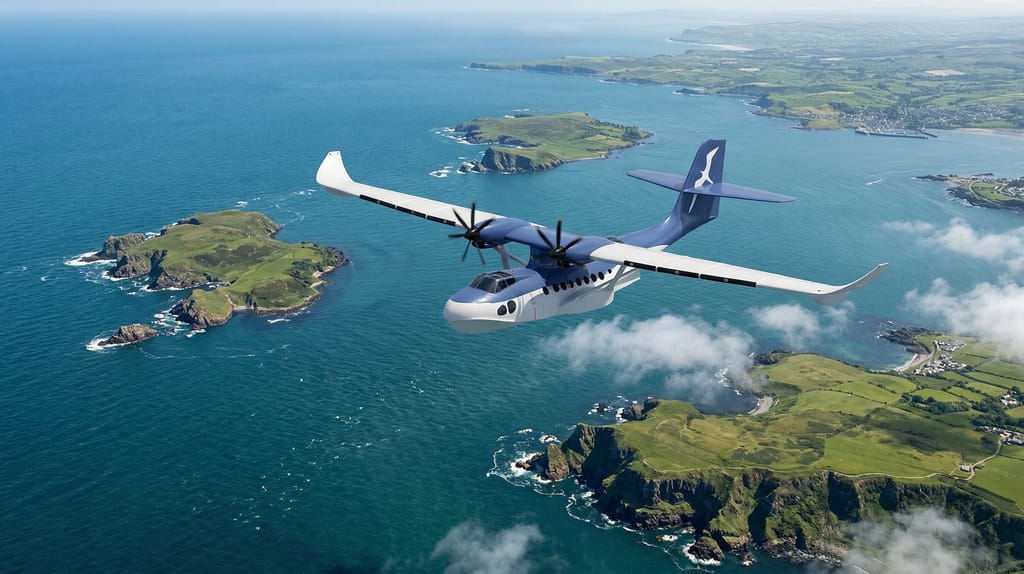
Catalina Aircraft Company announced plans for its Engineering and Technology Center (ETC) in Vero Beach, Florida, as it continues development of the Catalina SPAR™, a modern clean-sheet FAA Part 25 transport category amphibious aircraft platform built for global operators working across coastal, island, maritime, and infrastructure- limited environments.
The ETC is designed as a co-developed, multi-tenant innovation hub rather than a single-purpose engineering office. It will house Catalina Aircraft Company's own design team alongside other aerospace and hardtech startups, with shared access to heavy compute for digital-twin and systems-engineering work, a scale wind tunnel, a wave tank for hull and hydrodynamic testing, and 3D printing and materials labs. By combining these capabilities under one roof, the ETC is intended to shorten development cycles for the Catalina SPAR's aerodynamic, structural, and amphibious hull design work while giving outside tenants access to test and prototyping infrastructure that would otherwise be cost-prohibitive to build independently.
Catalina Aircraft Company structures the ETC as long-term, appreciating program infrastructure rather than a fixed engineering cost. Shared facility and equipment costs are offset by outside tenants leasing space and testing capacity, while the design, prototyping, and certification- support work performed on-site directly advances the Catalina SPAR program's development and FAA Part 25 certification timeline.
"The Engineering and Technology Center gives us the infrastructure to design, build, and test the Catalina SPAR right here in Vero Beach, while helping build out this region's broader aerospace ecosystem." said Bennett Biever, Vice President of Business Development at Catalina Aircraft Company.
The Catalina SPAR™ is designed as a multi-mission system rather than a single-purpose aircraft.
A platform configured for aerial firefighting can be repositioned for transport, patrol, humanitarian support, or search and rescue during off-season periods, reducing the need for multiple specialized fleets. This adaptability is central to Catalina Aircraft Company's approach to serving civil, commercial, and government operators worldwide.
The Catalina name carries deep significance in aviation history. The original Catalina PBY flying boats played a critical role in World War II, supporting long-range patrol, search and rescue, anti-submarine operations, and transport missions across multiple theaters. Known for their range, versatility, and reliability, they became the most widely used amphibious aircraft of their time, with some still flying today. Catalina Aircraft Company builds on that legacy while looking ahead to the next generation of amphibious aviation.
Vero Beach, Florida provides a strategic base for the company's U.S. operations. The region has a long-standing aviation history, including service as a U.S. Naval Air Station during World War II and later as a center for aircraft manufacturing and development. Catalina Aircraft Company's presence in Florida reflects both that aviation heritage and the region's connection to aerospace, maritime, and coastal markets with global reach. The ETC builds on this heritage, positioning the Treasure Coast as a hub for aerospace engineering, testing, and industrial development.
Catalina Aircraft Company is engaging with partners, operators, industry leaders, and government stakeholders as it continues development of the Catalina SPAR platform and prepares for future phases of growth.
The products and services herein described in this press release are not endorsed by The Maritime Executive.
