
Will the European Strait of Hormuz Force Float?
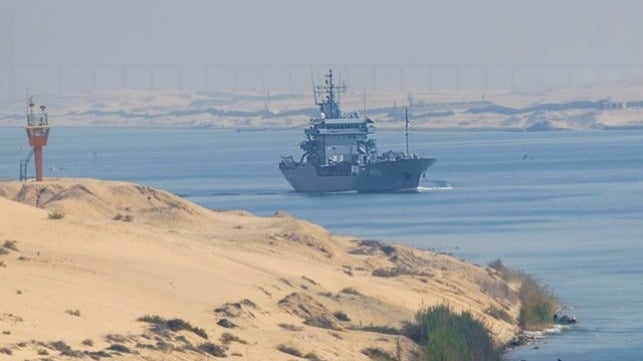
A flotilla of ships destined to bulk out the FS Charles de Gaulle Carrier Strike Group has joined up in the Arabian Sea, all part of the Anglo-French led coalition which is intended to monitor safe passage through the Strait of Hormuz once peace is established in the area.
The RFA Lyme Bay (L3007), the German minesweeper FGS Fulda (M1058), and the Elbe Class command and support ship FGS Mosel (A512) transited south through the Suez Canal and have now passed through the Red Sea. The Royal Navy air defense destroyer HMS Dragon (D35) came back through the Bab el Mandeb to escort the flotilla through the area where it was at most risk from the Houthis. The Houthis in recent weeks have threatened to resume attacks on shipping in the area, but have not done so as yet, so the deployment of HMS Dragon to provide air defense cover was a precautionary measure.
At present, the members of the G7-endorsed coalition are all drawn from European countries that are also members of NATO, so coordination of command and control within the force should not prove a challenge. The RFA Lyme Bay will act as a mothership for a multinational autonomous mine clearance effort, for which the Royal Navy’s contribution, a long time in the preparation, has been rushed through to operational readiness; this in itself is a major operational advance. The Germans are also fielding an autonomous mine clearance capability. It appears that the mine clearance capability will be led by a German officer, commanding from FGS Mosel, with a prospect that Italian minesweepers ITS Crotone (M 5558) and ITS Rimini (M 5561) will join up with this effort as well, and also possibly the Dutch minesweeper HNLMS Willemstad (M864). The French-led Charles de Gaulle Carrier Strike Group will be the stand-by response force.
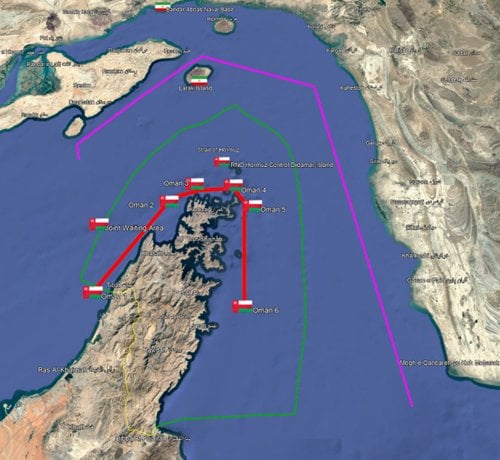
The Omani waypoints and channel for exiting the Gulf (red), the likely Iranian northern route (purple), and the extent of Omani territorial waters (green) (Google Earth, ©CJRC)

that matters most
Get the latest maritime news delivered to your inbox daily.
The question remains, though, whether both Iran and Oman will give their consent to the deployment of the force in the Strait of Hormuz. The Royal Navy of Oman’s evacuation plan, using the Oman coastal route through Omani territorial waters, avoids what are described as dangerous and uncleared waters through which the channels of original Traffic Separation Scheme pass through. Ships using the Iranian-designated and controlled exit route overseen by the Persian Gulf Regulatory Authority will pass to the north of this danger area. This leaves no immediate need to clear the waters in between, to the north and south of the median line, and Iran and Oman may feel the presence of a multinational force will be a complication rather than a contribution to maintaining stability.
This is particularly true if questions regarding rules of engagement and compliance with UNCLOS have not been resolved before the force deploys. These questions are likely holding back some potential contributors from making a final commitment of resources, for whom consent from the two coastal states is a pre-requisite. It has long been an Iranian strategic objective to reduce foreign presence in the region. So even though the coalition does not include US assets, the force may either not make it to an initial deployment, might have to withdraw shortly thereafter if the intensely complex talks in Switzerland break down, or could possibly morph into a UN peacekeeping mission.