
Why Network Engineers Are Worried About the Strait of Hormuz Crisis
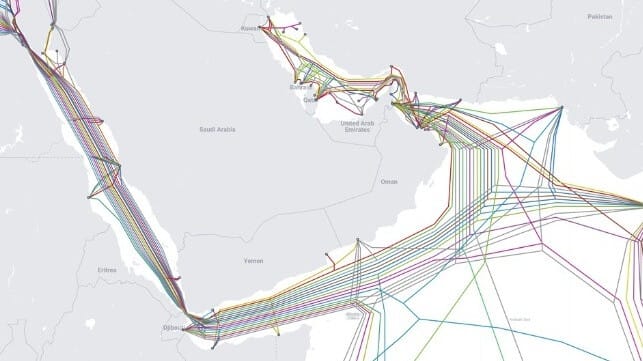
The Strait of Hormuz blockade has been widely analyzed from a global energy impact perspective, but network engineers are also concerned if the crisis persists. In a new analysis, UK-based cybersecurity firm FastNetMon highlights the elevated risk of internet disruption in the Gulf region. Besides being a critical chokepoint for oil and gas, the Strait of Hormuz is also a primary artery for international data traffic, with multiple subsea cables passing through the narrow corridor.
Gulf region internet connectivity hinges on cables passing through the Strait of Hormuz. While the internet is designed to reroute in case of disruptions in one area, the Gulf region faces a double challenge. The region depends on two primary connectivity corridors: the Red Sea and the Arabian Gulf. Both are now facing elevated risks due to ongoing instability on the two fronts. This presents a vulnerability for Gulf region connectivity.
To achieve redundancy for the region's international traffic, there currently exist five legacy submarine cables crossing the Strait of Hormuz. The cables approach from the Arabian Sea and land first along the Omani coast, referred to as the southern gateway for the region. From these entry points, branching units distribute capacity across the Gulf countries, connecting landing stations in the UAE, Qatar, Bahrain, Saudi Arabia, Kuwait and Iraq.
Historically, regional cable permits have favored routing through Omani waters, which has led the five cables to be closely clustered in one seabed path while crossing the Strait of Hormuz. In the current high-tension environment, FastNetMon assessed that this clustering has transformed from a matter of convenience into a critical vulnerability.
"From an operational perspective, redundancy in the Strait was historically achieved through multi-operator capacity. However, as of 2026, the industry has realized that this redundancy cannot compensate for the physical risk of a single narrow maritime corridor," FastNetMon added.
One of the five established Gulf subsea cables is the Asia-Africa-Europe-1 (AAE-1). Although it has a history of frequent cuts in the Red Sea, the 25,000 km cable remains one of the primary routes for internet traffic in the Gulf region. In recent months, the cable has been forced to carry overflow from newer, stalled cables, effectively becoming the most congested route in the region's cable network.
The SMW5 cable, for instance, has been operating in a degraded state due to unresolved electrical faults in the Red Sea, where the security situation has prevented access for deep-sea repair vessels. The unstable Red Sea route has also seen the Tata TGN-Gulf cable operating at its maximum design capacity. The cable has absorbed extra traffic from corporate users who have migrated from the unstable Red Sea cable systems.

that matters most
Get the latest maritime news delivered to your inbox daily.
Additionally, billions of dollars' worth of cable projects have been halted in the Gulf region, with some 90 percent complete. This represents lost potential for the region's high-speed internet ambitions. One such project is the 2Africa Pearls Extension, led by partners including Vodafone, Meta, Orange and China Mobile International (CMI). When completed, the 45,000 km cable will be the longest subsea cable ever deployed.
Unfortunately, the cable's landing in the Gulf region has been delayed. In March, Alcatel Submarine Networks (ASN) declared force majeure on laying the cable in the Persian Gulf as the region became a no-go zone. Most of the cable is now lying on the seafloor, with the final five kilometers of beach landing abandoned.
