
Video: WHOI Researchers Visit Wreck of Shackleton's Final Ship
A team of researchers are under way on an expedition to survey the famed shipwrecks of explorers Sir Ernest Shackleton and Captain Robert Falcon Scott, the aim of which is to capture and document images of the wrecks and enable the creation of 3D replicas of the ships.
In what is being termed a "once-in-a-generation" expedition, the researchers are returning to the wrecks of Quest and Terra Nova, the two ships that were captained by Sir Ernest Shackleton and Capt. Scott.
The Quest, a 125-tonne motor-sailing steamship, was rediscovered in 2024 lying at a depth of 390 meters off the coast of Newfoundland and Labrador. The schooner-rigged vessel served as Shackleton's last expedition ship on the Shackleton-Rowett expedition of 1921/22. The famed explorer died on board on January 5, 1922, after suffering a heart attack while the vessel was at anchor at Grytviken, South Georgia. He was aged 47.
The Terra Nova, for its part, was discovered in 2012 lying at a depth of 300 meters on the seabed off the southwestern coast of Greenland. The vessel carried Capt. Scott and his men on their doomed expedition to reach the South Pole in 1912. Though the ship continued in service after the polar expedition, she sank in 1943 while carrying supplies to U.S. bases during World War II after she was damaged by ice.
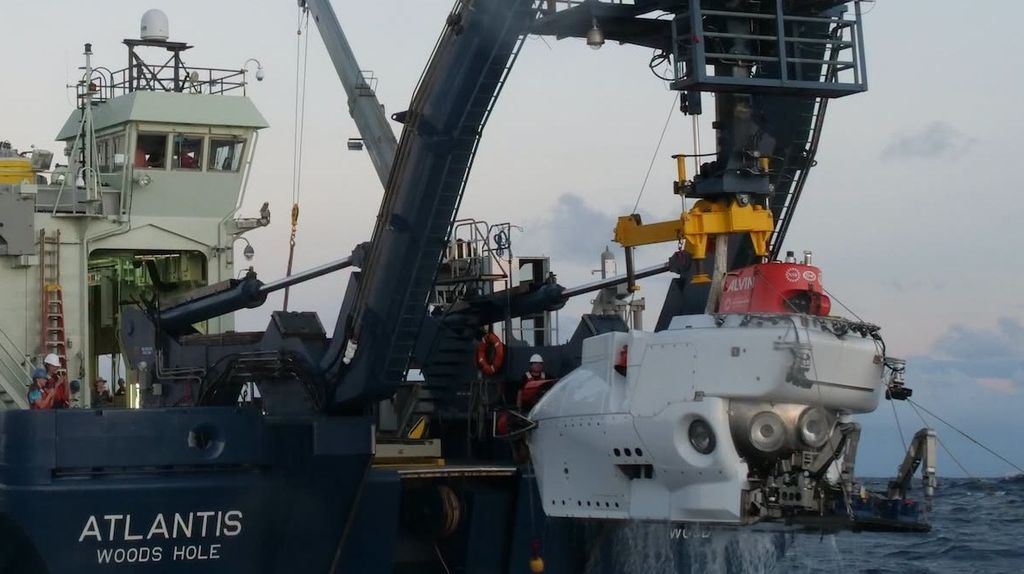
Following months of planning, the Royal Canadian Geographical Society (RCGS), in partnership with the Woods Hole Oceanographic Institution (WHOI), is in the middle of an expedition to film the two wrecks. The highlight of the mission so far was a dive by WHOI's human-occupied submersible Alvin to the wreck of Quest, the first time that people visited the wreck and saw it with their own eyes. It will also be only the second time that a submersible has reached Terra Nova.
Notably, the mission is the first for Alvin after the submersible was granted U.S. Navy certification to return to service after undergoing a routine overhaul and testing program. In service since 1964 and having completed more than 5,300 dives, the historic three-person deep-sea research submersible can now resume diving to depths of 6,500 meters. Alvin gained prominence for capturing the first images of the sunken Titanic in 1986.
Researchers aboard the WHOI-operated research vessel Atlantis are sailing to the wrecks of the famed polar ships, deploying a remotely operated vehicle (ROV) to undertake comprehensive visual surveys.
Using a combination of high-definition video cameras and photogrammetric technology, they will map the shipwrecks and debris fields around their hulls. The expedition will be groundbreaking because neither ship has been previously surveyed with this technology.

that matters most
Get the latest maritime news delivered to your inbox daily.
"By using advanced imaging tools, ROVs and the legendary Alvin submersible, we will be able to see and re-create two historically significant shipwrecks and bring the stories of two great explorers to life," said Dwight Coleman, WHOI Director of Ocean Imaging.
