
US Court Says Dali Lawsuit Against Hyundai Should Be Heard Elsewhere
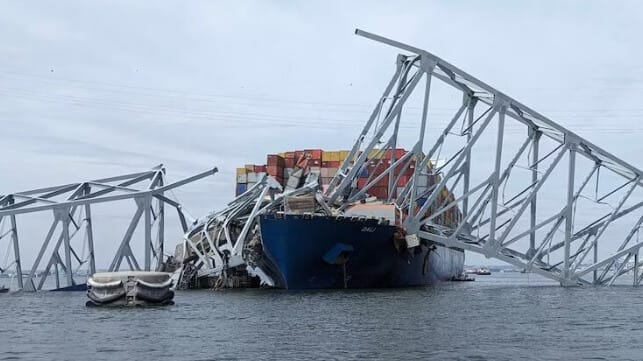
Shipbuilder Hyundai Heavy Industries won a court decision on August 3 in a suit brought against it by the owners and operators of the containership Dali regarding defects in the construction of the vessel. The court dismissed the case on a legal ground that finds another location is much more convenient and proper for the suit, and not on the merits of the claims.
Grace Ocean, as the owner of the Dali, and Synergy Marine, as the operator of the Dali, had filed an admiralty and marine action on July 31, 2025, against Hyundai Heavy Industries related to the blackout on the Dali, which caused it to hit and destroy Baltimore’s Francis Scott Key Bridge. The complaint cites two product liability claims, one breach of implied warranties, one claim of negligent misrepresentation, and a claim related to indemnity.
The owner and operator were in effect claiming that manufacturing defects in the vessel, which Hyundai built in 2014 and delivered in 2015, contributed to the failures on the ship and subsequent damage, which killed six roadworkers on the bridge. The National Transportation Safety Board in its investigation found that lose wire caused the ship to lose power, while a pending criminal complaint in Maryland cites the use of an improper pump that did not automatically restart after the blackout.
The product liability case was brought in the Eastern District of Pennsylvania, and the location was one of the issues that was under contention. In 2002, Hyundai Heavy Industries registered as a foreign business in Pennsylvania, and as such, Grace Ocean and Synergy argued it was a legitimate location to file the suit. The court ultimately agreed that it did have jurisdiction.
When the Dali was transferred in 2016 from its original owner to Grace Ocean, there was a contract that addressed the rights of the parties on issues such as future claims pertaining to the ship’s construction and warranty. A hearing held in July 2026 centered on the issues of this contract and whether Synergy Marine was a party to the contract. The contract also included a clause saying disputes would be submitted to arbitration in London.
The Pennsylvania court ruled that Synergy Marine was bound by the contract as well as Grace Ocean. Hyundai had also argued that it would be more appropriate for the case to be heard elsewhere, as the evidence and witnesses were in South Korea and Singapore. Hyundai was seeking a motion to dismiss or, alternatively, a stay pending arbitration.
In a ruling on August 3, the Eastern District of Pennsylvania dismissed the claims from Grace Ocean and Synergy Marine against Hyundai Heavy Industries on “forum non conveniens” grounds. It, in effect, agreed that the case would be more appropriate for another court. The Pennsylvania court did not comment on or rule on the product liability issues. The case was dismissed with prejudice, meaning the Pennsylvania court has permanently closed it.
It is the latest ruling in a tangled web of legal claims stemming from the March 26, 2024, incident. Grace Ocean and Synergy Marine have settled many of the civil claims with the U.S. federal government, Maryland, the families of the deceased workers, and others. They have argued in a District Court in Maryland that the remainder of the civil claims, mostly from businesses that cite a loss in revenue or were inconvenienced, should be dismissed.

that matters most
Get the latest maritime news delivered to your inbox daily.
The United States unsealed a criminal indictment in May 2026 against Synergy Marine and a technical supervisor on conspiracy and maritime safety violations, as well as obstruction by concealing information during the investigation. That case is currently scheduled to go to trial in October 2027. Both the company and the supervisor have entered pleas of not guilty.
The chief engineer of the Dali pleaded guilty to charges of failing to notify the U.S. Coast Guard of unsafe conditions on the vessel when it arrived in the United States. He has received a deferred prosecution, likely in exchange for testimony in the criminal trial.
