
Ukraine Increases Port Security as it Monitors Bulker That Sank Near Odesa
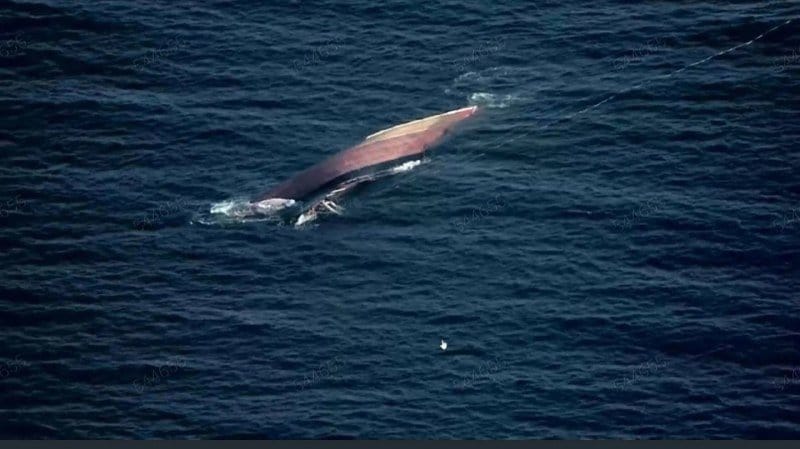
Ukrainian officials report that they have started an environmental monitoring effort and are coordinating increased security following the sinking of the bulker Golden Leo on Sunday, July 26. They, however, are emphasizing that the ports in the Odesa region remain open with shipping traffic continuing to move through the sea corridor.
An effort coordinated with multiple agencies in Ukraine responded on Monday, July 27, to a possible oil leak from the Golden Leo (7,334 dwt). The State Ecological Inspectorate said inspectors visited the site, which is approximately five nautical miles from the Odesa coast, to investigate initial reports of a possible oily spot on the surface.
As of Monday afternoon, they are saying there were no signs of contamination from the fuel, lubricants, or other fluids aboard the vessel. The stain was determined to be coming from the corn husks aboard the vessel, which had loaded 2,800 metric tons of corn at Chornomorsk.
The ship, which was built in 1998 and registered in Guinea-Bissau, was initially struck on July 19 during a Russian attack. A total of 10 were killed aboard the ship, including the Ukrainian pilot. Eight of the crew from Syria and India were rescued. The Ukrainians assert the vessel was struck by three Russian cruise missiles and succumbed to its damage, sinking on July 26.
The Seaports Administration reported that the Odesa regional State Administration is advising coastal communities to conduct constant monitoring for possible leaks from the ship into the Black Sea. They note that the vessel is likely to further deteriorate, and leaks may emerge.
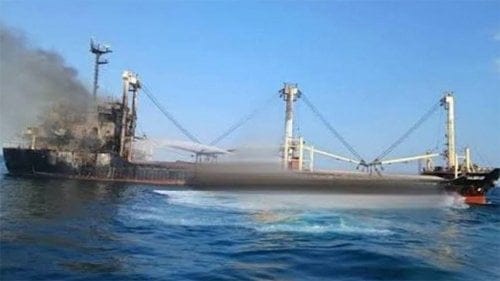
Golden Leo continued to burn for days before sinking on Sunday (Ecological Inspectorate)
At the same time, the Ukrainian authorities said joint security measures are underway to limit the risks to shipping. They are also cautioning vessels to follow the instructions of the local authorities.
Ukraine had requested a session of the UN Security Council to discuss the situation and its impact on the global grain markets. The Odesa prosecutor’s office reported that between June 20 and July 20, Russian forces had attacked 28 merchant vessels in the Greater Odesa ports. They said 21 people were killed and 34 were injured. Ukraine says it has lost about a third of its capacity to export grain from the Black Sea ports.

that matters most
Get the latest maritime news delivered to your inbox daily.
“We must not allow this dangerous escalatory spiral to continue,” Kayoko Gotoh, Director and Officer in Charge for Europe, Central Asia, and the Americas for the Office of Political and Peacebuilding Affairs and Peace Operations, told the Security Council. She reported that since early July, 170 civilians have been killed and more than 1,000 injured across Ukraine in intensified aerial attacks. Kyiv remains under “near-constant bombardment,” she told the Security Council, with at least 56 civilians killed and 232 injured in July alone.
Citing data from the UN Conference on Trade and Development (UNCTAD), the Council was told wheat prices have jumped by 20 percent since the beginning of July as ports in Odesa, Chornomorsk, Pivdennyi, Izmail, and Mykolaiv have come under sustained attack. Wheat prices are now at their highest since March 2024 as Ukraine and Russia continue to escalate their attacks.
