
UK Finds Fault in Planning and Medical Care on Cruise Ship in Severe Storm
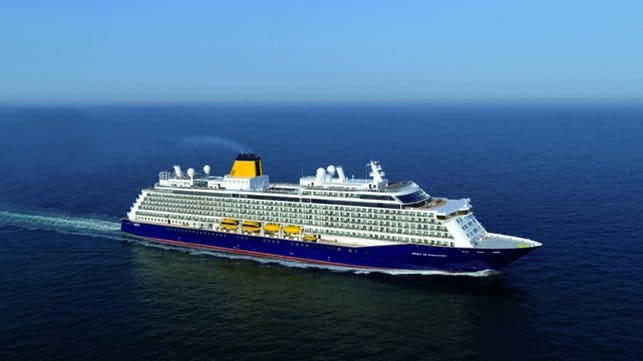
The UK’s Marine Accident Investigation Branch issued its report on a 2023 incident aboard the cruise ship Spirit of Discovery in which many passengers were injured, including one who later died, as the vessel lost propulsion during a violent storm in the Bay of Biscay. The report outlines significant steps that have been taken to address a range of safety issues, while the UK, along with the Norwegian authority, is making recommendations to the IMO and class societies to enhance equipment and instruction manuals.
The Spirit of Discovery is a new cruise ship delivered in 2019 by Meyer Werft to Saga Cruises in the UK. The ship is 58,000 gross tons and 237 meters (777 feet) in length with a capacity of approximately 950 passengers and 500 crew. It uses two podded azimuth drives for propulsion. Saga is a brand focused on older adults, and the ship was operating a two-week cruise to the Canary Islands from the UK with 943 passengers. The youngest passenger was 50 years old, the oldest was 96 years old, and the average was nearly 79 years old.
The cruise ship lost propulsion during a violent storm in the Bay of Biscay, resulting in injuries to over 100 passengers. The report looks at the decision made to cross the Bay of Biscay despite weather warnings and the problems in the implementation of a mass casualty plan on board.
“A complex sequence of events led to this accident, and we have identified a number of clear lessons around vessel safety, crew decision-making, and medical response,” said Chief Inspector of Marine Accidents, Rob Loder. “I am encouraged by the swift action taken by the vessel’s owner, manager, and manufacturers, but I urge the cruise industry to learn the lessons from this tragic accident.”
The cruise ship company, Saga Cruises, told the BBC it accepts the MAIB report but that it disagrees with some of the conclusions. It notes, as cited in the report, that prompt actions were taken to enhance policies and procedures.
Synopsis of the Incident
The captain and the shore team had become aware of the weather reports and a prediction for heavy weather on October 29, 2023, and began discussing how to adjust the cruise. They decided to cancel the final scheduled port call in the Canary Islands and proceed to A Coruña, Spain, for a call on November 4 to 5 before heading to Portsmouth, UK, believing they would be behind the storm. However, they were later advised that the Spanish port would be closed, and the decision was made that the ship should proceed immediately to the UK, which meant it would have the storm on its port side.
Preparations were made on the ship, including closing public spaces on the upper deck and advising passengers of the expected heavy weather. According to the report, some passengers asked why the ship did not seek shelter in a port to wait out the storm.
The cruise ship entered the Bay of Biscay around 0800 on November 4 and began encountering storm force 10 wind and very rough seas. The ship, by midday, was making approximately 16 knots with westerly winds between force 8 and 9.
At 1230 the cruise ship’s port pod water leakage stop sequence alarm activated, and shortly thereafter, the port pod propeller overspeed alarm activated. The pod went into an automatic shutdown, which included rotating 90 degrees inboard, which greatly limited the ship’s ability to maneuver. At 1236, the starboard pod experienced the same issues and shut down.
The ship was rolling violently as the captain attempted to regain control. At about 1245 the engineers were able to restart the starboard pod and return the propulsion system to bridge control. The captain was using the bow thruster and single pod in an attempt to stabilize the ship in a hove-to situation. However, the fin stabilizers were automatically set to withdraw when the bow thruster was engaged. It would take until 1308 to restore the port pod at reduced speed, and they were later able to manually override to resume use of the fin stabilizers.
Between 1300 on November 4 and 0420 on November 5, the cruise ship’s pods intermittently overspeed eight more times and shut down. The engineers were generally able to restore the pods in about 10 to 15 minutes.
The weather had deteriorated, with the winds increasing to force 10 and then hurricane force 12 before falling to force 8 early on November 5.
Unfortunately for the passengers, the incident started during meal service in the main dining room on Deck 5. They were advised to remain in their cabins and limit movement, but in total, 115 passengers were injured. The most serious case was an 85-year-old man who was seated in the lounge when his chair tumbled over backwards, and he rolled onto the floor. He complained of neck pain, but there was a delay in getting adequate medical care. He was eventually placed in a neck brace but began to experience paralysis.
The decision was made that it was too risky to airlift him and the other more seriously injured passengers, and they stayed aboard until the ship docked in the UK late on November 6. The injured man died four days later in a hospital. Seven other passengers were also taken to a hospital in the UK.
Conclusions and Recommendations
MAIB identified some design issues, including the low position of the pod bilge sensor, which caused the shutdown sequence with only a small amount of water. It also found that the operating instructions for the propulsion system were incorrect and made the officers unaware of the risk of losing propulsion. However, the ship had experienced two separate incidents of overspeed shutdown about eight months earlier.
They also found the decision to cross the Bay of Biscay was in part made due to optimistic reliance on the shipbuilder’s seakeeping and maneuvering decision support poster. MAIB believes the voyage planning did not adequately assess the likely voyage motion and potential effects on elderly passengers. It also says the decision to cross the Bay of Biscay was not effectively challenged by the crew and operational teams on shore.
They also found that the lack of implementation of the mass casualty plan contributed to the medical team becoming overstretched. They also concluded that the crew had not risk-assessed whether the furniture was suitable for heavy weather and noted a lack of handholds in elevator lobbies, which they believe contributed to the injury of passengers.
A broad set of actions has been taken by the vessel’s managers and owners, as well as Siemens Energy Global, which supplied the control system for the propulsion system. Builder Meyer Werft also created additional seakeeping and maneuvering decision information. Lloyd’s Register also placed limits on the class certificates until the overspeed and water leakage issues were investigated and resolved.

that matters most
Get the latest maritime news delivered to your inbox daily.
Finally, the UK’s Maritime and Coastguard Agency and the Norwegian authority are jointly calling for requirements to include electronic inclinometers, which is also in part a follow-up to an earlier incident with a Viking cruise ship off Norway in a violent storm. They are also making a recommendation that the class societies improve the quality of instruction manuals.
The complete 56-page report is available online for further review.
