
Study: Wealthy Countries Fuel Illegal Fishing in Poor Countries
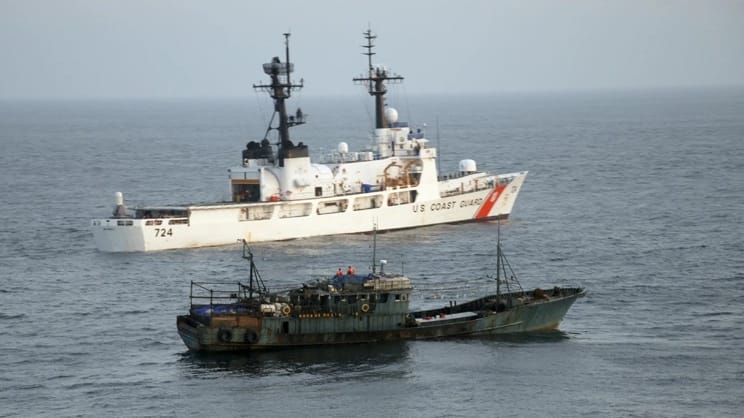
Consumers in wealthy nations are fueling a rampant illegal fishing trade that has become a multibillion-dollar industry, and the majority of the catch originates in the waters of poor countries, according to a comprehensive study from Canada’s University of British Columbia.
Fishing is a socioeconomic lifeline for most coastal communities across the globe, with about 3.5 million fishing vessels plying the world’s oceans, providing livelihoods and food for millions. But the world seems to have resigned itself to being unable to tackle illegal and unreported fishing, with sporadic crackdowns targeting vessels and arrests of perpetrators failing to eliminate the illicit activity.
Now researchers are lifting the lid on the structure of illegal fishing, arguing that it has long ceased to be a fringe activity and is today a systemic feature of the global seafood economy. Illegal fishing continues to thrive despite decades of regulation and advances in technologies like satellite tracking, artificial intelligence, and electronic monitoring that have dramatically improved detection. Yet fragmented enforcement, weak penalties that cannot deter violations, and uneven political will mean an end to illegal fishing remains a distant prospect.
According to the study, illegal fishing accounts for eight to 15 percent of the global marine wild capture and is currently worth about $6-12 billion annually. Industrial-scale fleets are the drivers of the trade, accounting for about 82 to 93 percent of the 8.4 million to 15.4 million tonnes of illicit marine wild fish traded each year.
The study shows that wealthy nations in North America, Europe, and East Asia are fueling the illicit trade as the biggest consumers of illegally caught seafood. Roughly two-thirds of the catch by value originates in West Africa, East Asia, and Southeast Asia, the hotspots of illicit activity. West Africa accounts for 27 percent of the illicit catch, followed by East Asia at 24 percent and Southeast Asia at 16 percent.
The study, published in the Proceedings of the National Academy of Sciences, documents how illegal and unreported catch finds its way into legal markets. It highlights how sophisticated laundering mechanisms — at-sea transshipment, fraudulent documentation, mislabeling of fish species, and the mixing of illegal and legal catch — allow illegally caught seafood to cross borders and evade detection. Weak port controls, variable adherence to international rules, and opaque vessel ownership provide illegal operators with a further edge.
Large, subsidized distant-water fishing fleets are the biggest culprits. Most of these vessels are from China and Taiwan, and many use familiar open registries, favorable corporate jurisdictions and anonymous ownership for maximum efficiency.
Most of the distant-water fleets are from China and Taiwan, with others from Japan, South Korea, and Spain. Driven by economic incentives like subsidies and high-value fish markets, most concentrate their illegal activity in the Pacific, West Africa, and East Africa, where enforcement capacity is poor and governance limited.
“Illegal fishing remains profitable because the risks are low and the rewards are high. Even as detection improves, enforcement and accountability lag behind, particularly for large industrial fleets operating far from public scrutiny,” said Philippe Le Billon, the study’s lead author.

that matters most
Get the latest maritime news delivered to your inbox daily.
The authors contend that to reduce illegal fishing, authorities must change tack and move away from a focus on catching individual offenders. Instead, a systematic approach would start with fixing the systems that make the trade profitable while making illegal fishing harder to carry out.
Abolishing harmful fisheries subsidies is one of the biggest available interventions in creating a level playing field for the legal industry. Mandating electronic vessel identification, strengthening port state controls, increasing transparency of ownership and improving international cooperation would also help, the authors suggested.
