
Saudi Arabia Builds Maritime Coalition to Keep Red Sea Shipping Moving
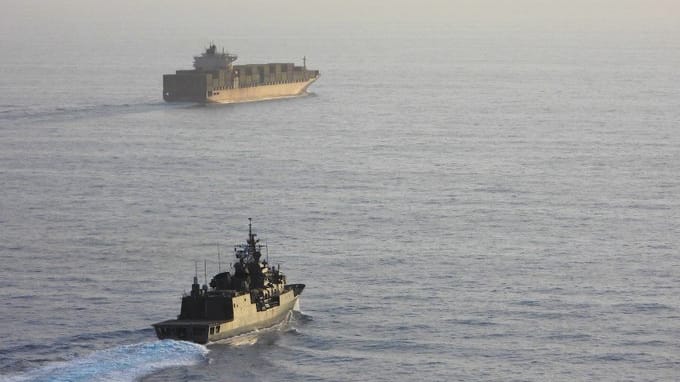
Saudi Arabia convened an inaugural meeting in Riyadh on July 30 of nations interested in joining a maritime defense coalition to “enhance maritime security, protect international maritime corridors, and counter threats targeting maritime navigation and global trade.” The maritime corridor in question appears to be the Maritime Transit Security Corridor (MTSC), the trade route passing through the southern Red Sea, the Bab el Mandeb, and the Gulf of Aden.
It was reported that 43 of 50 invited nations attended the inaugural conference. Some defense attachés were sent along to the meeting, no doubt to keep an eye on developments for their capitals, but without any long-term intention of joining. The European Union, which currently runs Operation Aspides, which has a very similar mission, was also an attendee. Of those attending, 14 nations issued a joint statement, envisaging that the new coalition would conduct joint maritime operations in the MTSC area, which would necessitate its own operational command and control structure and access to resources to create a maritime intelligence picture. The joint statement said that the new structure’s Joint Operations Coordination Center, a subordinate Joint Maritime Operations Center, and the organization’s General Secretariat would be based in the Kingdom.
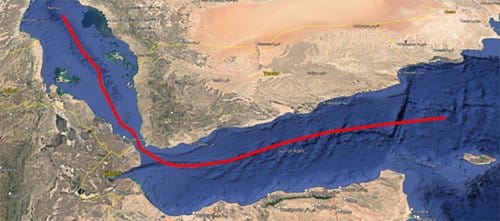
The Maritime Transit Security Corridor trade route through the Red Sea and the Gulf of Aden, along which passes about 10% of global trade (Google Earth/CJRC)
The 14 co-signatories were apparently ready to be founding members, namely Bahrain, Bangladesh, the Comoros, Djibouti, Egypt, Jordan, Kuwait, Pakistan, Qatar, Saudi Arabia, Somalia, Sudan, Turkey, and Yemen. There was, however, some confusion as to who had finally put pen to paper.
Among those attending the conference was the United States, but no NATO or Western nation was included as a founding member.
Saudi Arabia’s convening role, and its preparedness to host – and presumably pay for - the organization’s command and control structure, is an indication that it does not want to be cast by the Houthis as its stand-alone enemy in the conflict in Yemen. The Houthi blockade and offensive announced in mid-July is directed primarily at Saudi Arabia, from whom it is trying to extract concessions and compensation as part of the final settlement negotiations to bring about an end to the 12 year civil war in Yemen. Saudi Arabia’s coalition counters this by bringing together those primarily impacted by the economic costs of the Houthi action, while Saudi Arabia’s military response to Houthi attacks has been muted and designed not to create a spiral of attack and counter-attack.

that matters most
Get the latest maritime news delivered to your inbox daily.
Oman has not signed up to the coalition, probably to preserve its neutral role as the convener of the ongoing Houthi-Saudi peace negotiations. Nor has the United Arab Emirates, which still retains military bases along the MTSC littoral, bases that could have particular utility in maintaining a naval operation to counter the Houthi threat in the area.
It is not clear yet when the coalition will be ready to activate its naval operations, which will encompass the escort of merchant shipping through vulnerable sections of the MTSC, and presumably both the naval means to intercept incoming attacks and the capability to attack Houthi units, which may be preparing to engage merchant shipping. It is implicit in the shape of the coalition seen so far that the naval capability will be based on a core capability furnished by the Royal Saudi Naval Force’s Western Fleet, headquartered in Jeddah, supported by elements of the Royal Saudi Air Force.
