
Russian Naval Boost for President Putin
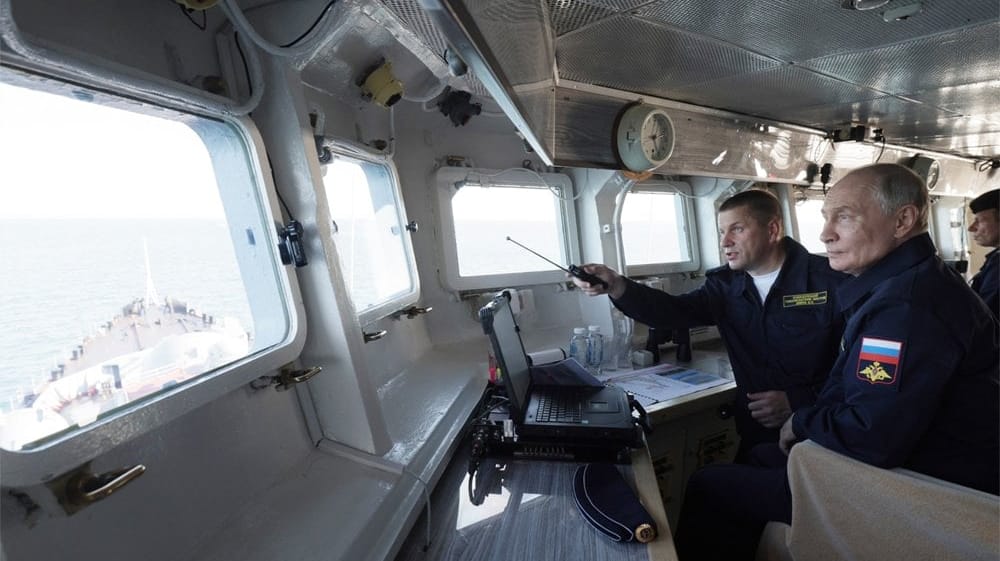
President Vladimir Putin paid a visit to the Russian Navy’s Pacific Fleet during its major annual exercise, which began on August 4, a visit made with heavy political overtones.
Putin made the most of his visit to the pride of the Pacific Fleet, Slava Class missile cruiser RFS Varyag (D11), pictured in naval uniform on the bridge and eating on the mess deck with some very nervous-looking Russian sailors.
During the tour, President Putin made an unprecedented visit to the Kurile Islands, in Russian hands since the Japanese population was evicted in 1945, but still very much wanted back by Japan. There he visited a fish processing plant, a hospital, a school and one of two airbases on the island of Iturup. Japanese Prime Minister Sanae Takaichi said that Putin’s trip “offends the sentiments of the Japanese people and is absolutely unacceptable,” making it “more difficult to restore relations in the medium to long term.” In the short term, President Putin may see electoral advantage in presenting himself as a defender of Russia, and during the visit he talked up the threat posed by the United States, Japan, and AUKUS. The September 18–20 State Duma elections will be the first electoral test for President Putin since the start of the war against Ukraine. His party will win, of course, but the turnout and margin of victory will be a test for the loyalty he commands.
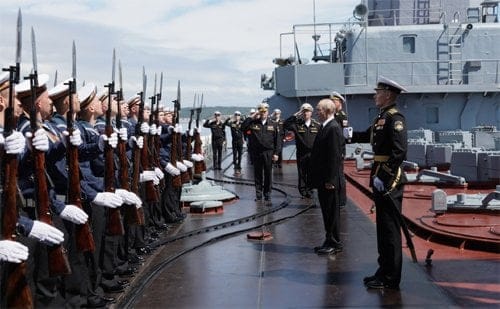
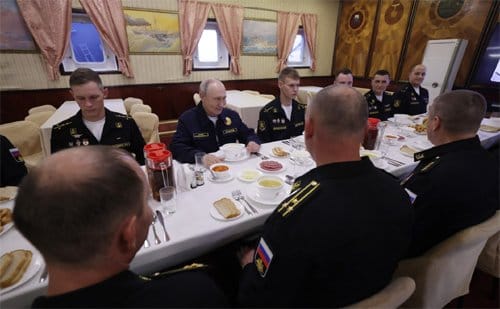
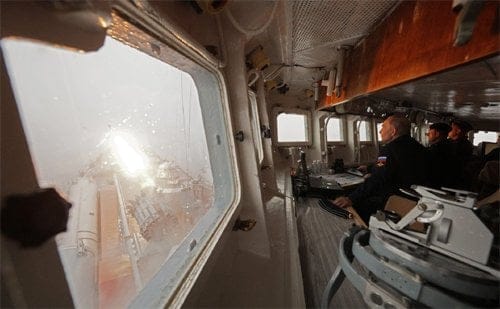
President Putin aboard the RFS Varyag (photos from Presidential Press and Information Office - CC BY 4.0)
The Pacific Fleet exercise involved 60 surface ships, submarines, support vessels, about 30 aircraft, helicopters, and unmanned aerial systems of the Pacific Fleet’s naval aviation, and altogether involving 13.000 service personnel, reports TASS. It took place in the Sea of Japan, the Sea of Okhotsk, and in the Pacific off the submarine base at Avacha Bay. The exercise formed part of a worldwide exercise of Russian naval fleets named July Storm, covering the Baltic, Caspian, and Northern Fleets – although the Pacific Fleet exercise appears to have started on August 4 and was over within a few days.
According to its commander Admiral Viktor Liin, the operations practiced by the Pacific Fleet focused on defense of maritime borders, island zones, and coastal territories in Russia’s Far East.
In one exercise phase, a minesweeper force consisting of the Pacific Fleet’s three Alexandrit Class minesweepers RFS Anatoly Shlemov, RFS Pyotr Ilyichev, RFS Yakov Balyayev, and the Project 266ME MT-265, plus the Sonyya Class wooden-hulled coastal minesweepers BT-100 and BT-256 cleared minefields in a channel. In another phase, Grachonok Class specialist port security vessels (recently seen in Tartus), alongside FSB border guard detachments on board small craft, detected maritime drones of the notional enemy approaching the Russky suspension bridge near Vladivostok. Mi-8 and Ka-27PS helicopters carrying anti-terror units were scrambled and successfully disabled one of the drones using small arms fire, and then remaining unmanned surface vehicles (USV) were destroyed by strike-capable drones launched from ships involved in the exercise.
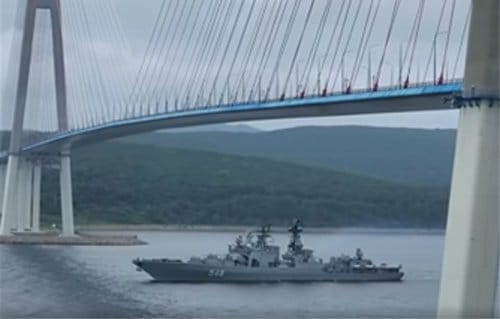
Udaloy Class guided-missile destroyer RFS Admiral Panteleyev (F548) deploys on the exercise under the Russky suspension bridge over the harbor entrance into Vladivostok (Social media)

that matters most
Get the latest maritime news delivered to your inbox daily.
TASS in its coverage of the exercise, printed a picture of the very smart-looking Borei Class (Project 955) ballistic missile submarine RFS Vladimir Monomakh (K-551). The submarine has served with the Pacific Fleet since 2016 and is equipped with 16 × Bulava SLBMs. It conducted live-fire testing of its missiles in November 2015 and in December 2020. It is not known if the Vladimir Monomakh participated in the exercise, but a Kilo Class submarine was seen instead leaving Vladivostok with other exercise participants.
While the Pacific Fleet was exercising and enjoying lunch with President Putin, a sustained Ukrainian drone attack on Novorossiysk overnight August 12 hit two Admiral Grigorovich Class frigates, RFS Admiral Makarov (F959), and Admiral Essen (F751), both confirmed as damaged but still afloat in satellite imagery seen afterwards, plus a number of other ships. There were reports of widespread fires on the dockside.
