
No Signs of Peace in the Gulf
From activity noted, there are few if any indications from the Gulf region or in the Strait of Hormuz area that a ceasefire or an end to the war is imminent.
The blockade of Iranian ships and ports goes on unabated. On May 29. U.S. Central Command reported that US naval forces had disabled Gambian-flagged 71-meter general cargo vessel MV Lianstar (IMO 9072692) in the Gulf of Oman after the vessel ignored repeated warnings that it should not attempt to make for an Iranian port. A U.S. helicopter fire a Hellfire missile into the ship’s engine room, disabling the vessel.
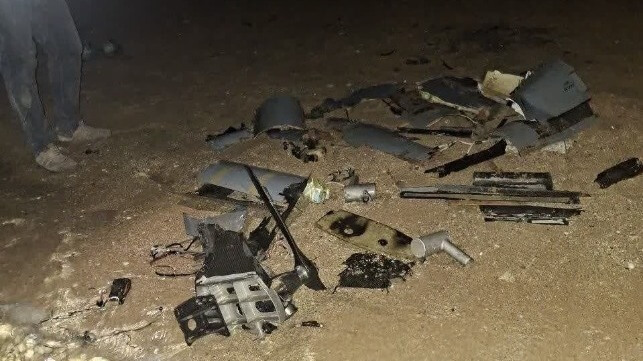
The day after, the Iranian Army showed off the debris of an Orbiter reconnaissance drone which it shot down just off the coast of Qeshm Island.
Oman’s Maritime Security Centre warned all shipping on May 29 that an object floating west of the westbound channel of the recognized Traffic Separation Scheme was probably a sea mine, warning shipping to be on special alert and to report any suspicious sightings.
At the Kharg Island terminal further into the Gulf, there were no ships on the eastern loading piers. The last time there was activity spotted was on May 21, when two small tankers were at the pier, suspected of loading oil for internal transfer within the Gulf. A large number of tankers were waiting off the terminal on May 28, as there have been now for several weeks.
Perhaps prompted by reports that the Kooh Mobarak oil terminal near Jask was inoperable, despite the huge investment made in developing it as an alternative export terminal on the Gulf of Oman, a 313m-long tanker arrived at the Single Point Mooring (SPM) on May 29. From a visible oil slick it appeared to be loading. As in previous days, the Guinea-flagged and OFAC sanctioned Vernon (IMO 9232876) was seen anchored 1.75nm due south of the SPM, where she has been since May 19.
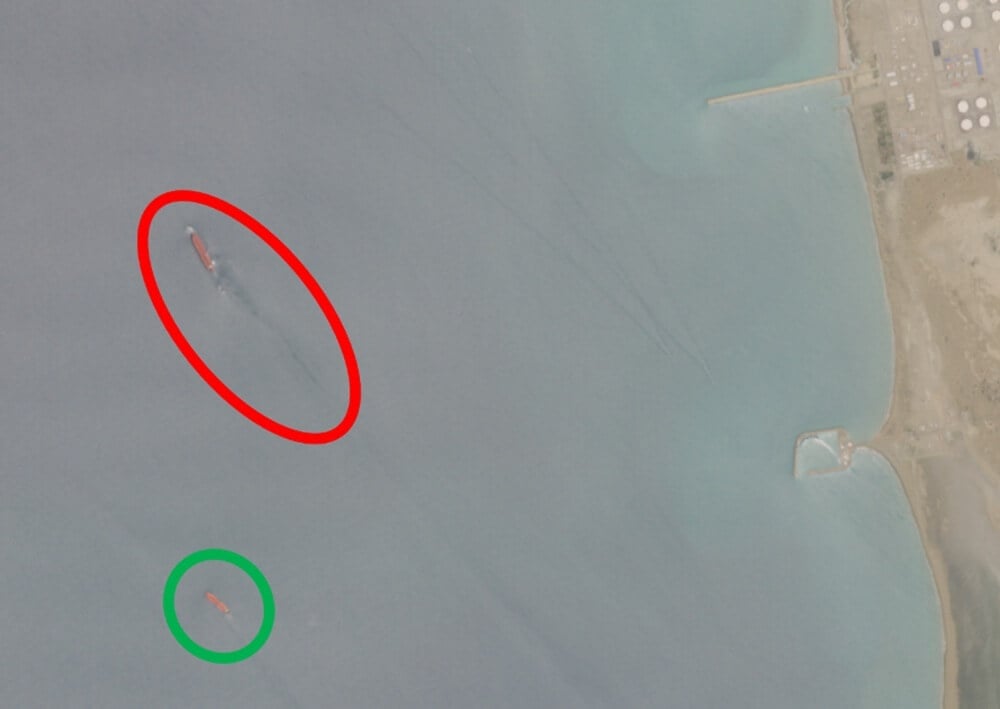
A 313m-long tanker (red) loading on the Kooh Mobarak SPM on May 29, with the Aframax Vernon (green) still anchored close by (Sentinel-2)
On the political front, the Iranian parliament has been pressing forward with legislation to enable the so-called “Persian Gulf Strait Authority,” which now handles administrative functions for the IRGC-operated shipping channel near Larak and Qeshm. At the same time, US Treasury Secretary Scott Bessent has warned that anyone dealing with or handling money with the authority will be subject to US sanctions, which will effectively deter most global shipping lines from using the channel in Iranian waters.
Secretary Bessent also has been pointing out what has become increasingly obvious from the to-and-fro of the US-Iranian negotiations – that the Iranians are desperately short of money. The economic situation before the war in Iran was already very serious. Now the Iranian government also has the cost of restoring destroyed infrastructure, to add to the pre-existing financial difficulties. Even if sanctions are lifted, it will take many months for oil money to start flowing into Iran’s Ministry of Finance – but to fend off social unrest in the days after the war is settled, for example by raising food subsidies or purchasing food supplies from abroad, the need for emergency funding is immediate.

that matters most
Get the latest maritime news delivered to your inbox daily.
Statements of defiance from Mohammad Baqer Qalibaf, Speaker of the Iranian Parliament and head of Iran’s negotiating team, expressing Iran’s determination to concede nothing and accept nothing on the basis of promises, do not necessarily reflect a hardening of Iran’s negotiating position - although Iran has certainly created some bargaining strength by its shut-down of the Strait of Hormuz. It can also be interpreted as a desperate need to obtain immediate funding up-front, without which the Iranian security structure will have difficulty keeping unrest under control.
On balance, Iran has the greater need to settle the war quickly, whereas the United States can carry on with its blockade at relatively low risk of casualties and with little direct impact so far on the US economy (except for a 2.4 percent increase in consumer prices and a 50 percent increase in the price of gasoline since February). The Gulf states are divided. But most do not want to see the war restarted, and have adapted to living without access through the Strait of Hormuz for the time being; as the Qataris have demonstrated in their bilateral negotiations with the Iranians this week in Doha, they do not want to see the Iranian regime boosted by being granted access to immediate funding.