
Japan's Navy Withdraws From Operating Antarctic Research Icebreaker
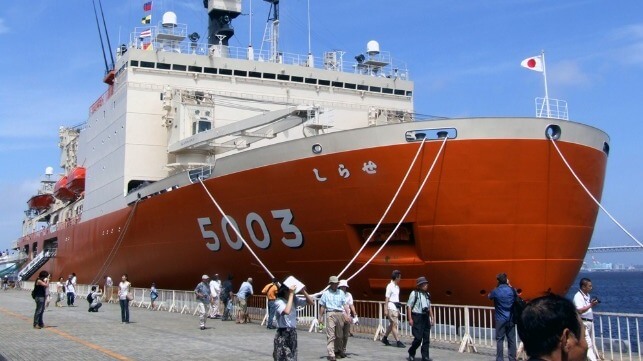
The Japan Maritime Self Defense Force will cease to operate the country’s Antarctic research vessel Shirase due to military personnel shortages. According to reports in local media, Japan’s navy will hand over the operations of the polar vessel by the early 2030s. This coincides with the expected decommissioning of Shirase in 2034.
The navy’s withdrawal is planned to be gradual, leaving only a support unit to assist with duties such as ice navigation. Currently, 180 MSDF personnel are assigned to crew the icebreaker; with the change, the active-duty crew complement is expected to reduce to 30.
The operations of the successor vessel will be taken over by a civilian body, with the Japan Agency for Marine-Earth Science and Technology named as the potential candidate. MSDF has been operating icebreakers for the Japanese Antarctic program since 1965.
Over the years, the navy has operated three icebreakers, starting with Fuji, which was in service from 1965 to 1983 (Japan has had four icebreakers but the first was civilian-operated). AGB Shirase replaced Fuji and was in service up to 2008. The current icebreaker, also named Shirase, made her maiden voyage in November 2009.
Shirase recently completed the 67th Japanese Antarctic expedition, with the research mission focusing on Totten Glacier in East Antarctica. With the icebreaker operations transitioning from the navy, defense sources said that the move could allow more flexible planning of Antarctic research missions.
Already, civilian agencies are heavily involved in logistical planning of Antarctic studies, coordinated by the Japanese Antarctic Research Expedition (JARE) within the Ministry of Education, Science and Culture. Going forward the ministry will constitute a panel to develop a transport framework for future expeditions.

that matters most
Get the latest maritime news delivered to your inbox daily.
The handover of operations has been informed by the fact that advances in navigation technology have significantly lowered risks of sailing in polar regions, and Japan considers missions exclusively led by civilian organizations to be practical now.
With the changing geopolitical environment globally, the Japanese military has signaled its intention to fully utilizing its manpower for core defense duties. This comes amid concerns of personnel shortages. Japan's defense ministry estimates that personnel could shrink from 220,000 in 2024 to around 180,000 by 2035, even as Japan hopes to expand its defense commitments in its near abroad.