
Japan Launches Trial Voyage to Recover Rare Earths From the Seabed
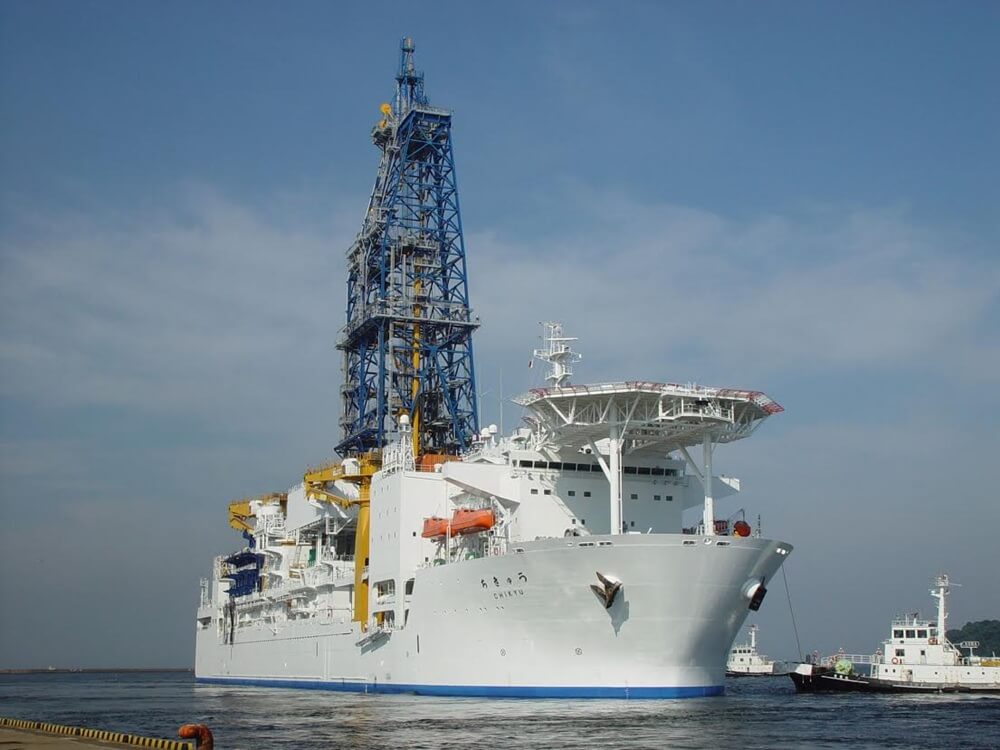
When it comes to subsea mining, polymetallic nodules get most of the public interest and investor focus, but they're not the only resource base in the deep. Japan's Agency for Marine-Earth Science and Technology (JAMSTEC) has just launched a trial expedition to recover mud from the seabed in Japan's far-flung Pacific territory, hoping to extract rare earth elements from the sediment on the bottom.
The Japanese research drillship Chikyu got under way from Shizuoka on Monday, bound for Minamitori Island. Near the remote atoll lies a rich deposit of rare earth elements, potentially measured in the millions of tonnes. If recoverable in commercial quantities, and if domestically refined, the deposit could satisfy Japan's needs for many of the high-tech manufacturing ingredients it currently has to import from China. In an era of rising competition in East Asia, this would be a strategic resource, giving Japan more independence of action.
"The goal is to secure a domestic supply to enhance national security, rather than to enable private companies to profit from selling rare earths," Japanese Cabinet Office official Shoichii Ishii told Reuters last year.
Japanese researchers discovered the trove of concentrated rare earth ore deposits in clay sediment in 2013. The sediments contain commercially-valuable yttrium, europium, terbium and dysprosium in vast quantity. Importantly, the mud is low in radioactive compounds, so extracting and processing it from the sediment would be less environmentally harmful. The sheer volume of material-handling required is daunting: for every tonne of mud extracted, just four pounds of the target minerals will be recovered.
The journey from discovery to production has taken so long in part because the technology to perform the resource recovery did not previously exist. JAMSTEC had to invent systems for ultradeepwater drilling - deeper than rated operating depths for a 7th-generation drillship. The pipe for the drillstring is also fully customized to deal with the abrasive, viscous mud.

that matters most
Get the latest maritime news delivered to your inbox daily.
Development of deep sea mining resources could come at a cost, researchers and environmentalists warn. Extracting material from the seabed surface means damaging or removing seabed habitat, and the excess sediment that is returned to the water could potentially harm marine life, depending on volume and location of placement. In the case of Chikyu, the mud will be extracted by a cylindrical device on the end of the drillstring and pumped up to the ship for processing. The layer containing rare earths is thin, according to Japan Times, so the ship will have to change position often to pick up more material.
If the trial run with Chikyu proves successful, JAMSTEC wants to move to full-rate production at the site in early 2027.