
France Pulls Back Carrier and Reshuffles Arabian Sea Flotilla
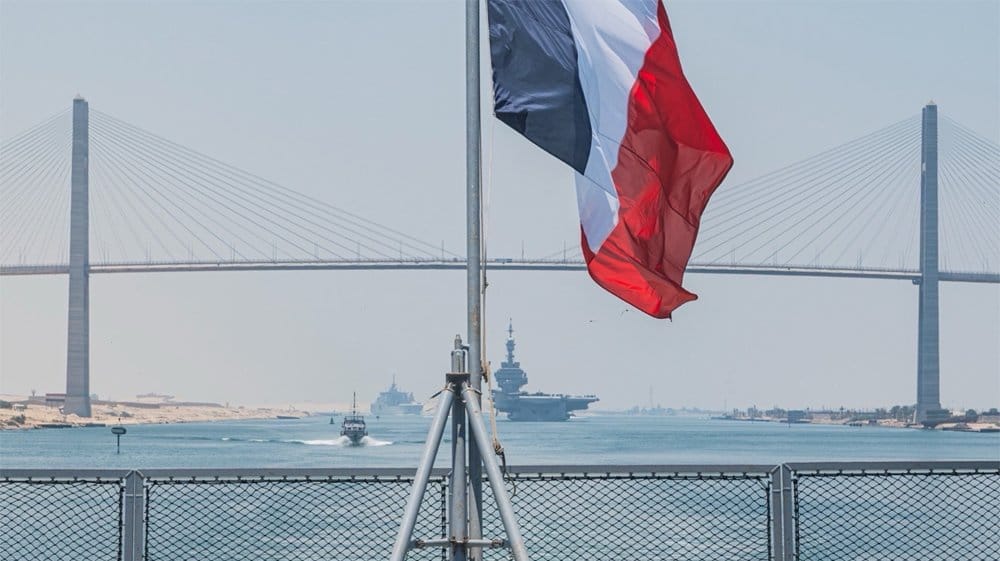
France is changing its naval deployments in the Middle East.
The demise of the Coalition of the Willing naval task force, which was patrolling the Arabian Sea, was announced two weeks ago by The Maritime Executive. The force, led by the FS Charles de Gaulle (R91) carrier strike group and with a German-commanded mine clearance force, was intended to help secure the Strait of Hormuz once a peace deal had been achieved. But it was apparent that the Iranians, nor probably the Omanis, would be happy to have the force operating in their territorial waters, and moreover, the return of a stable situation, which was a precondition for its deployment, looked increasingly unattainable.
It now transpires that France has reshuffled its naval forces in the region. The French Navy exercises much tighter operational security than most other services, rarely releasing the names and movements of ships on deployment. It thus managed to hide the movement of the FS Charles de Gaulle (R91) northwards up the Red Sea and through the Suez Canal on July 3, although @AtlasObserver detected that the 03.00 convoy that morning included a vessel without an IMO number, supposedly and unblushingly named Superman1.
A subsequent post on X by French President Emmanuel Macron confirmed that the Charles de Gaulle was heading home for Toulon, and the carrier arrived on July 11. A picture released of the carrier transiting the Canal showed that it was being accompanied by fuel and dry stores replenishment ship FS Jacques Chevallier (A725). The President also announced that the remainder of the carrier’s escorts were remaining behind in the Arabian Sea, reinforced with two mine hunters.

that matters most
Get the latest maritime news delivered to your inbox daily.
Thus reconfigured, what remains of the Coalition of the Willing naval force is now primarily oriented towards mine clearance, made up of the two French mine hunters, the German command and support ship FGS Mosel (A512), the minesweeper FGS Fulda (M1058), and autonomous mine warfare mothership RFA Lyme Bay (L3007). The Italian minesweepers ITS Crotone (M 5558) and ITS Rimini (M 5561), supported by the patrol vessel ITS Montecuccoli (P455), are holding off under EU NAVFOR Aspides command and based in Djibouti. Royal Navy air defense destroyer HMS Dragon (D35) is out there in the ocean somewhere. Without a strike element, the force would either need to operate once a definitive peace settlement had been reached between the warring parties, and with the permission of the two littoral states. Or it could integrate into the US 5th Fleet, providing a specialist mine-clearance capability operating within a wider naval coalition.
The reconfiguration of the French naval deployment in the Arabian Sea now makes it harder for such a force to operate in an offensive role, possibly reinforcing the EU Operation Aspides, should the Houthis decide to resume their attacks on shipping. Houthi rhetoric is still heating up, focused on relations with Saudi Arabia and air access to Sana’a Airport. But a Houthi resumption of attacks on shipping might still yet be forestalled, to the chagrin of the under-pressure IRGC, as UN-led negotiations are still active and ongoing.
