


European Naval Coalition for Hormuz Disappears Without a Trace
Without formal notice, the European-led naval force - which was intended to safeguard the Strait of Hormuz once it was safe to do so - appears to have foundered without any formal announcement of its demise. Up to 40 nations had expressed an interest in supporting the plan.
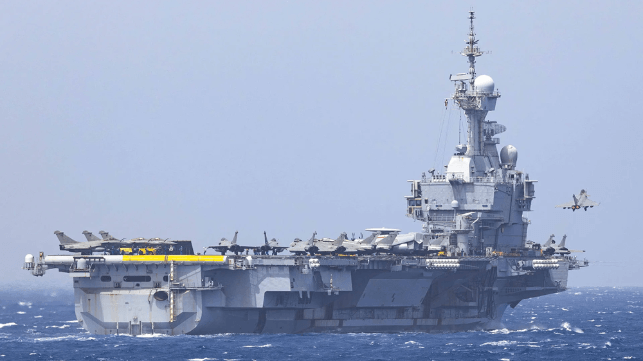
Lead ships of the force remain forward-deployed in the Arabian Sea, utilizing the multinational naval shore facilities in Djibouti. A carrier strike group is led by the FS Charles de Gaulle (R91), made up French escorts including an Aquitaine Class anti-submarine warfare destroyer and the Royal Navy air defense destroyer HMS Dragon (D35), all supported by the fuel and dry stores replenishment ship FS Jacques Chevallier (A725). A mine warfare group is commanded from the German ship FGS Mosel (A512), and includes the minesweeper FGS Fulda (M1058) and autonomous mine warfare mothership RFA Lyme Bay (L3007). Italian Navy’s minesweepers ITS Crotone (M 5558) and ITS Rimini (M 5561), supported by the patrol vessel ITS Montecuccoli (P455), are slated to join the force, but in the meantime are under EU NAVFOR Aspides command and based in Djibouti. Other European naval vessels are also under the Aspides command in the meantime, waiting for the Hormuz force to be activated.
Under the operational concept, the Hormuz force would not deploy until the ceasefire in the Strait becomes permanent and the environment non-confrontational. That is a long way from being realized, but the plan also depends on permission being granted by the two littoral states, Iran and Oman, for the force to operate in rather than pass though territorial waters. Some commentators would regard a plan to deploy a naval force only when it will not be required to fight as being fatally misconceived. The force was to have formed part of outgoing British Prime Minister’s Sir Kier Starmer’s legacy, bolstering his standing as an international statesman alongside his Defence Investment Plan. The Hormuz plan is likely to be formally retired once Sir Kier Starmer himself has also formally retired in the near future.
Iran has made it clear the Hormuz force is not welcome, it having been a long-standing strategic objective of the Islamic Republic to rid the region of external military forces. Through the Mehr News Agency, Iran’s Deputy Foreign Minister Khazem Gharibabadi announced on July 4 that ‘the Strait is not a military display arena for extra-regional powers’. ‘The security of Hormuz lies with its littoral states’, he said, in a warning directed specifically at France and the United Kingdom.

that matters most
Get the latest maritime news delivered to your inbox daily.
Oman, for its part, has said that the clearance of the Strait is a responsibility placed on Iran under the Memorandum of Understanding agreed between Iran and the United States. Oman would not interfere with or override that responsibility placed on Iran. On this basis, the implication is that if Iran needed assistance with clearing mines the IRGC had laid, then that would be a matter for which Iran should request assistance. On Sultan Haitham’s recent visits to both France and the United Kingdom, there was no reference nor support for the Hormuz force. However, the statement issued after the French visit made it clear separately that Oman was ‘committed to free, unconditional, unrestricted navigation through the Strait including the right of passage in accordance with the law of the sea’.
There does not appear therefore to be either a welcome, nor indeed even a role for the Anglo-French led force. All however may not have been in vain. Tension has been rising in Yemen in recent weeks, with the Houthis carrying out a society-wide general mobilization and making increasingly hostile rhetorical attacks on Saudi Arabia. If conflict is to break out again in Yemen, and the general ceasefire broken which has been in force since April 2022, then inevitably conflict would spread to the Red Sea and Gulf of Aden. At that point, with the Americans heavily committed elsewhere, the EU NAVFOR Aspides operation - which is already mandated with keeping sea lanes open - might have need of the naval resources which have been forward deployed for the abortive Hormuz operation.
The opinions expressed herein are the author's and not necessarily those of The Maritime Executive.
