
Smuggling Chief Who Was Implicated in Beirut Blast Steps Down
A key figure in Hezbollah’s smuggling operations in Lebanon, and a godfather figure in particular in the Beirut docks, Wafiq Safa resigned his formal position on February 6 as head of Hezbollah’s Liaison and Coordination Unit.
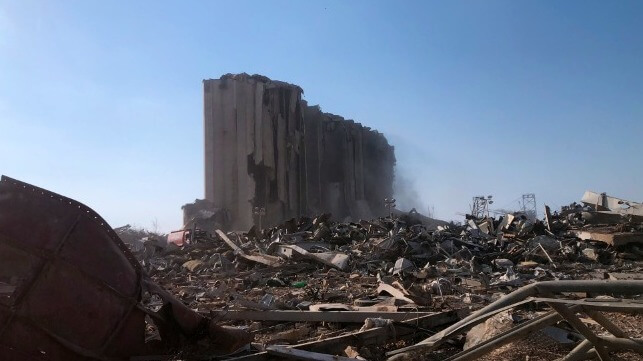
Wafiq Safa is regarded as having had a crucial role for at least 25 years in the organization of Hezbollah smuggling activities through the Port of Beirut. In all likelihood, he was behind a scheme to pilfer the cargo of 2,750 tons of ammonium nitrate stored in the Port of Beirut dockside warehouse where it had been offloaded from the impounded MV Rhosus (IMO 8630344) in 2014. By the time the remaining estimated 552 tons exploded on August 2020, most of the ammonium nitrate had probably been shipped to the Syrian government for use in explosives manufacture.
 Wafiq Safa, Hezbollah’s Head of Liaison and Coordination, in happier times. After recovery from an Israeli air strike, one of the few senior Hezbollah figures to survive 2024, Wafiq Safa until recently remained a key figure in Hezbollah’s smuggling operations (Tasnim / CC BY)

What is less in doubt is that since the explosion in 2020, which killed 218, injured thousands and devastated the port and a wide area of central Beirut, Wafiq Safa has played a key role in sabotaging the investigation of the incident. This involved getting the investigation by the resolutely brave Judge Tarek Bitar temporarily closed down, but also the murder of four witnesses with crucial evidence who would have testified to Judge Bitar.
Israeli sources reported that journalist Lukman Slim, photographer Joe Bejjani, and two Beirut Port customs officials, Joseph Skaff and Mounir Abou Rjeily, had been murdered by Hezbollah’s internal security Unit 121, to prevent them from testifying.
Unit 121 has a history of murdering even loyal Hezbollah members as a preventative measure to ensure that secrets remain secret, and Wafiq Safa is probably lucky to have avoided a similar fate – so far. By unusually allowing Wafiq Safa to step down, Hezbollah may be signaling that it seeks to reset its relationship with the Lebanese authorities, which in recent months has become increasingly strained as the Lebanese government asserts national sovereignty. Hezbollah has nominated Ahmed Muhanna to be Wafiq Safa’s replacement.
This may be good news for the continuing clampdown on Hezbollah’s smuggling operations. Wafiq Safa’s portfolio of talents covered smuggling (working with the IRGC’s Unit 190) and clandestine control of the Port of Beirut, as well as political liaison. But Ahmed Muhanna’s CV is weak on smuggling and more focused on political and diplomatic engagement. Moreover, with Israel wary of renewed threats from the north, Hezbollah leaders and operatives tend to remain alive only if they are relatively ineffective.

that matters most
Get the latest maritime news delivered to your inbox daily.
Management and development of the Port of Beirut was taken over by CMA CGM in March 2022, with the French firm having previously taken control of the Tripoli container port in 2021. Under the new CMA CGM regime, these ports are less likely to be used for bulk importation of obviously military items, but smaller and dual-use items will still be sneaked through, albeit in lesser volumes.
The focus for seaborne smuggling may now switch to coastal tramps sailing from Turkey and using small unregulated ports and fishing harbors along the length of the Lebanese coast. Syrian security forces continue to make seizures in border areas of arms and ammunition destined for Hezbollah.
The opinions expressed herein are the author's and not necessarily those of The Maritime Executive.