
Third LCO2 Carrier to Launch Europe’s Largest Carbon Capture Project
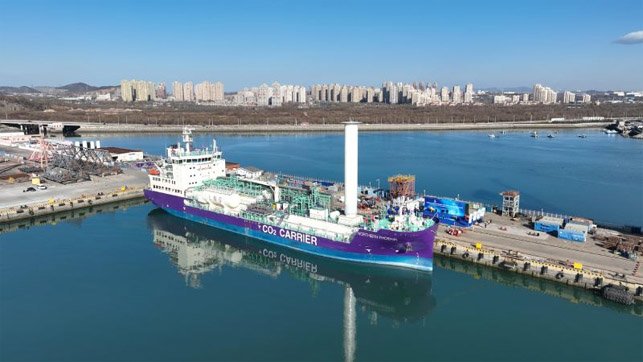
Norway’s Northern Lights project, along with Japanese ship operator “K” Line (Kawasaki Kisen Kaisha), marked the delivery of the third commercial liquefied CO2 transport vessel. The ship named Northern Phoenix will join the operation in 2026 and be part of Europe’s largest carbon capture project.
The ship is a sister to the first two Northern Lights’ vessels, which were delivered in late 2024 and began the commercial CCS program in 2025. It is the first commercial carbon capture project transporting the liquified gas cross-border and preparing and storing it more than 2.6 kilometers (1.6 miles) beneath the seabed on the Norwegian continental shelf.
The vessels, with a capacity of 7,500 cubic meters of LCO2, are being built by Dalian Shipbuilding Offshore Co., a division of China State Shipbuilder Corp. The Northern Phoenix was officially handed over on December 2 and is registered in Norway. It is expected to depart China shortly. Northern Lights reports the ship will conduct testing and optimization of its energy-saving devices during the repositioning voyage. Once it arrives at the company’s terminal in Øygarden, it will start mechanical commissioning and training before starting its operations.
The first three vessels are each being operated with bareboat charter contracts and time charters with “K” Line Energy Shipping based in London. In addition to their unique capability to transport LCO2 (maximum pressure of 19 bar(g) and minimum temperature of -35 degrees C), the ships are fueled with LNG and have a wind-assist rotor sails and air lubrication under the hull.
Commercial operations began in 2025 with Northern Lights under contract to transport and store CO2 from two Norwegian industries, Heidelberg Materials’ cement factory in Brevik and the Hafslund Celsio’s waste-to-energy plant in Oslo. Northern Lights has already announced plans to increase its operations to an annual capacity to handle a minimum of five million tonnes of CO2.
The third vessel will be dedicated to the transport of CO2 from Yara’s flagship ammonia and fertilizer plant in the Netherlands. Yara reports it will begin to capture and liquify up to 800,000 tons of CO2 annually at the plant. It expects to remove approximately 12 million tons of CO2 from its production at the plant in Sluiskil over the next 15 years.

that matters most
Get the latest maritime news delivered to your inbox daily.
Yara has invested in the facilities at the plant, which include an on-site storage capacity of 15,000 tons of CO2. The plan calls for two shiploads per week to be transferred to the Northern Lights’ vessel for delivery to the receiving station in Norway. From there, it is pumped to the storage site.
In December 2023, Northern Lights announced an agreement to build a fourth vessel. It will be owned and operated by Germany’s Bernhard Schulte Group. Northern Lights signed a long-term time charter party for the cross-border transport of CO2 and now says the vessel will be delivered in 2026. It reports that the vessel will permit it to expand operations with new customers, including Stockholm Exergi.