
Lockheed Unveils Drone That Can Hitchhike on Ship's Hulls
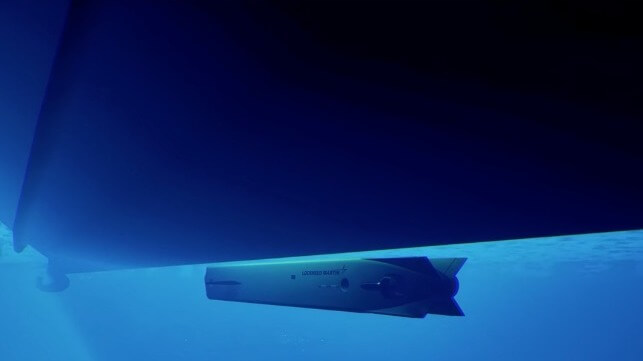
Lockheed Martin has unveiled a new autonomous unmanned vessel (AUV) class designed for long endurance, named Lamprey in a nod to its unique ability to hitch a ride on vessel hulls.
Lamprey is intended to fill a variety of mission sets for the Navy. The clearest application in peacetime is for ISR purposes, as small robotic submersibles can evade detection while gathering useful information. In conflict, the same stealth capability could be used for sea denial: the drones could get close enough to launch an attack without warning, or loiter on the bottom until needed, like a flexible and capable mobile mine. Other use options include electronic jamming, decoy deployment, aerial drone deployment and precision strike operations. Deployed en masse, the Lamprey could be used for sea denial, operating with AI and working in teams.
Most interestingly of all, the Lamprey is designed to hitchhike, unlike competing products. It can attach to a ship or a submarine and ride to its operating area, recharging on the way by catching the passing current with propeller-driven generators. No "host modification" is needed, suggesting that it could be used on vessels of opportunity (perhaps even unknowningly). The 24-cubic-foot payload bay is large enough for lightweight torpedoes or for launching aerial drones.

that matters most
Get the latest maritime news delivered to your inbox daily.
Lockheed's device arrives in a marketplace pioneered by others. Tech startup Anduril has developed a drone sub for Australian use, dubbed Ghost Shark, and Boeing has been working with the Navy on its XLUUV / Orca program for years. The MSubs/Royal Navy Excalibur program recently began testing and evaluation, and BAE Systems plans to have a market-ready large drone sub - Herne - by the end of this year. The Royal Navy has rapid and ambitious plans to use unmanned platforms to patrol the GIUK Gap, freeing up scarce manned assets.
China has extra-large unmanned underwater vehicles (XLUUVs) of its own, far larger than the Boeing XLUUV / Orca, their purpose and mission unknown in the public domain. Two have been spotted in testing near Hainan, according to Naval News.