
HD Hyundai Buys Tiny Welding Robots for Human Shipbuilding Tasks
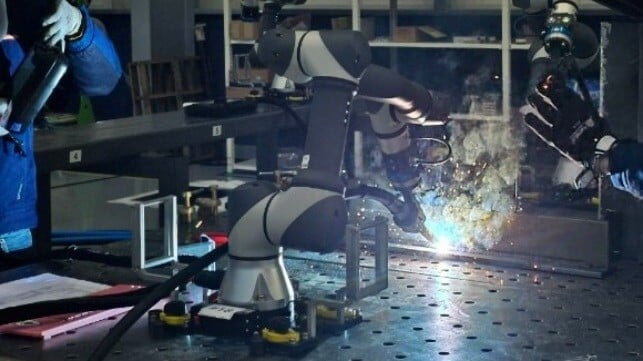
HD Hyundai Heavy Industries has begun using compact, lightweight welding robots that can be moved around the shipyard to automate complex welding tasks - even inside the interior of a ship under construction. The development brings robotic repeatability and speed to tasks that were previously reachable only by human workers, who are in short supply in Korea's shipbuilding industry.
The new capability is the product of a joint initiative between welding robot builder JCT and precision-control company Rainbow Robotics. The robotic arm weighs about 24 pounds and fits in a suitcase, and has been designed and tested for shipyard operations - including welding unusual shapes and curvatures.
The real challenge for this kind of work is not in the hardware - welding robots have been around for decades - but in the controls. Each steel joint location is well-defined in digital drawings of the ship's scantlings, but the task of manually programming each specific arm movement in sequence to carry out each weld would be a challenge every time the robot is picked up and moved.
Instead, software developed by HD KSOE links the digital drawings of the ship to the robot's control systems, and the robot uses these diagrams to figure out where and how to weld, without time-consuming human guidance.
"RB series collaborative robots can be applied to various welding methods without separate coding, enabling rapid automation even in complex environments such as shipyards," Rainbow Robotics CEO Lee Jung-ho confirmed to Chosun Daily.
Chinese shipyard industry publication EWorldShip reports that HD Hyundai has bought 35 of Rainbow Robotics' devices and HD Hyundai Mipo has purchased another 27, for a total of 62. When including all other announced mobile robot buys across the conglomerate's Korean footprint, EWorldShip estimates that HD Hyundai now has on site (or on order) a total fleet of about 170 units - nearly double the number it had the same time last year.
The change is driven in part by Korea's demographics. As experienced welders and fitters retire, there are fewer young Korean nationals interested in taking up a shipbuilding career. The Korean "Big Three" shipbuilders actively recruit in international labor markets to bring in guest workers, including trainees from Vietnam and Thailand. This pattern is now expanding across Korea's manufacturing landscape: a recent survey by the Korea Enterprises Federation found that 45 percent of small manufacturers need more foreign workers, mostly because of difficulty in hiring locals.

that matters most
Get the latest maritime news delivered to your inbox daily.
In addition, Korea faces fierce shipbuilding competition from China, where heavy state subsidies and government backing have built a globally dominant sector that competes hard on both price and (increasingly) quality. Tech proponents believe that robotic systems provide a direct answer to all of these competitive challenges - labor availability, production cost and consistency - so long as the technical hurdles of integration into the workflow can be solved.