
Hapag-Lloyd Buys Out ZIM
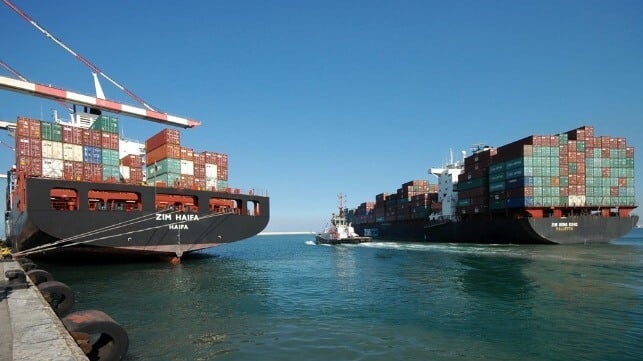
Number-five container line Hapag-Lloyd has agreed to buy 10th-ranked carrier ZIM, Israel’s de facto national shipping line. A heads of agreement has been reached by the two parties, and ZIM’s board approved the deal on Sunday night. Israeli business publication Calcalist reports that the transaction value exceeds $4 billion.
ZIM, publicly listed since 2021, is headquartered in Haifa. The deal entails Hapag-Lloyds’s purchase of all issued shares, and then the delisting of the company from the New York Stock Exchange.
Hapag-Lloyd has a partner in the deal, the Israeli private equity firm FIMI. Whereas international aspects of the ZIM business will be taken on by Hapag-Lloyd, Calcalist reports that the German liner will sell a subset of the firm’s operations to FIMI, thereby retaining sealift and sovereign shipping capacity in Israeli hands.
FIMI’s new company will reportedly be called “Zim Israel” and will hold all of ZIM’s owned hulls, along with key operations centers and personnel within Israel. The chartered-in fleet will be transferred to Hapag, along with international ZIM routes that do not intersect directly with Israeli commerce.
ZIM is a strategic Israeli asset, with a specific role in keeping Israel stocked to fight wars. For this purpose, the Israeli government has held a golden share in the company, and has mandated both that ZIM must be operationally controlled from Israel and must maintain a minimum number of ships on the Israeli register.
ZIM has since 2021 upgraded its fleet through a combination of owned vessels and chartered-in tonnage. It operates 70 regular liner services, and had a record turnover of $8.43 billion in 2024 after struggling in the previous decade. Turnover for the full year 2025 is likely to be down, impacted by lower freight rates. In the third quarter, EBITDA was down 61 percent, and TEU volume carried decreased 5 percent. Revenues were off 36 percent. Inevitably, Houthi attacks targeting Israeli shipping in the Red Sea and elsewhere have had an impact, with trade in particular through Eilat being badly affected.
By comparison, Hapag-Lloyd turned over $22 billion in 2024, and is heading for a similar figure in 2025, with an 8% increase in volumes shipped. It operates 305 ships and 130 regular liner services, and Alphaliner rates it as the fifth largest global shipping company.
The agreement has been negotiated within a very well secured Deal Room, such that unions and employees have been caught by surprise – and have not necessarily been brought along with the process. However, the very purpose of the takeover may have been to embrace a strategy for dealing with Houthi attacks and boycotts, while also protecting Israeli strategic interests.

that matters most
Get the latest maritime news delivered to your inbox daily.
The proposed arrangement has been in the works for a while, and the initial proposal was controversial in Israeli political and national-security circles.Critics note that Hapag-Lloyd’s major shareholders include investment vehicles controlled by the Qatari and Saudi governments, which have not always seen eye-to-eye with Israel. As of September, Qatar Holdings retained 12.3% and Saudi Arabia’s Public Investment Fund 10.3% of Hapag-Lloyd shares, a consequence of Hapag’s acquisition of UASC in 2017. Beyond geopolitics, ZIM's existence is a matter of identity: its history predates the modern state of Israel, and the company provided sealift capacity during the events leading up to the nation’s creation.
The deal follows the rejection of an earlier buyout offer from long-time ZIM CEO and president Eli Glickman, backed by Israeli shipowner Rami Ungar, who controls ro/ro company Ray Shipping. ZIM’s board turned down the Glickman-Ungar proposal in November, claiming that it undervalued the company.