
Hanwha Defense and HavocAI Team Up on Midsize Unmanned Vessels
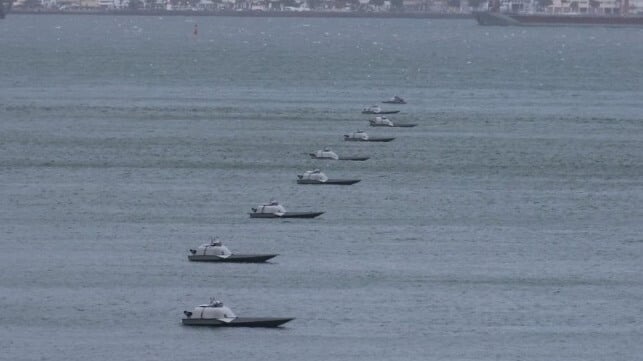
Korean industrial conglomerate Hanwha has been expanding its portfolio of projects in the U.S. naval and defense space, and on Thursday it announced a new agreement with an American autonomous-vessel company to compete in the medium-sized unmanned warship space.
The deal pairs Hanwha Defense USA and Hanwha Systems with HavocAI, a two-year-old startup run by two Navy veterans. Jointly, the firms will explore building a 200-foot-long autonomous surface vessel, and Hanwha Philly Shipyard is under consideration as the place of production. The goal is to deliver "state-of-the-art ASVs at scale," according to Hanwha Defense USA CEO Michael Coulter.
HavocAI specializes in adaptive collaborative autonomy for the control of multiple vessels at once. Its engineers design "systems that self-organize to anticipate, plan, and adapt in dynamic environments." The objective is to enable a single human operator to control a fleet of various unmanned assets. Potential mission sets include force protection, logistics in hostile environments, maritime strike, and area surveillance, among others. Its designs range from small craft up to a 100-foot trimaran design, dubbed Atlas. The firm says that its technology is already out accomplishing missions, and that it has been demonstrated in GPS-denied environments.
"Militaries will need to be able to fight without persistent connectivity and will need to execute autonomous "combined arms" . . . and detect and engage targets at machine speed with operators on, not in, the loop," the firm said in a statement last year.
In October, HavocAI raised $85 million in a funding round, making it one of the fastest-expanding startups in the space. Its main objectives for the capital raise include integrating its swarming-autonomy stack into even larger vessel sizes and growing its overseas presence in the Indo-Pacific.

that matters most
Get the latest maritime news delivered to your inbox daily.
HavocAI has not yet sought to buy its own shipyard site, like competitor Saronic, which is pursuing vertically-integrated development; the agreement with Hanwha gives it a road to large-scale production. Together, the two companies will jointly develop a 200-foot ASV proposal to include technical features and mass-production planning.
"The Department of War has sent a clear demand signal to the shipbuilding industry: we need more boats, faster, with more capabilities, for less money,” said Paul Lwin, Co-founder and CEO of HavocAI. “Partnerships like this – pairing a leading-edge technology with an established global infrastructure – are exactly how we achieve that goal.”