
Dead Whale on Boxship's Bow Prompts Investigation
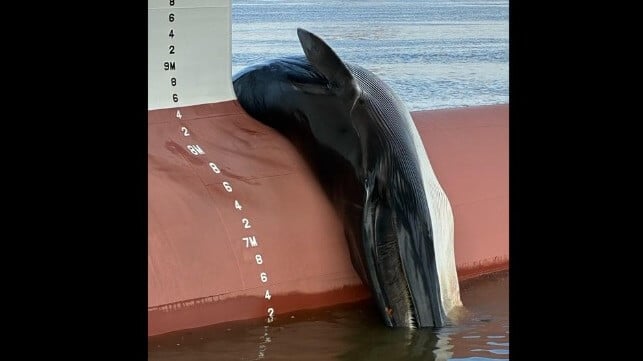
A small container ship arrived in Camden, New Jersey last week with a dead fin whale on the bulbous bow, and an investigation into the cause of death is under way.
Late Sunday night, Coast Guard Sector Delaware Bay reported a deceased whale on the bow of a reefer boxship at the north end of the Gloucester City Marine Terminal, next to the Walt Whitman Bridge. NOAA and the nonprofit Marine Mammal Stranding Center (MMSC) were alerted, and MMSC tentatively identified it as a fin whale of about 25-30 feet in length.
On Tuesday, personnel from the MMSC worked with contractors to remove the whale's carcass from the bow and tow it away to a secure site on the shoreline for a necropsy. However, on Thursday, the agency said that it was still looking for an approved place to bury the 13-ton whale after the work is done. Once the logistics for disposal are arranged, its team can begin.
Identified using image geolocation and AIS traffic records, the ship appears to be a Bahamas-flagged reefer boxship of about 14,000 dwt capacity. The vessel departed Peru in mid-December, AIS data provided by Pole Star Global shows, and it transited northbound for the Panama Canal, Caribbean and U.S. eastern seaboard, making 10-14 knots. It departed Camden on January 5 and headed back south towards the Panama Canal.

that matters most
Get the latest maritime news delivered to your inbox daily.
It is not yet been determined whether the whale died by ship strike. Fin whales are listed as endangered in the United States, but the global population is more robust. They are vulnerable to ship strikes, and statistics suggest that they are hit more often than other species. In some regions, ship strikes are the greatest risk to their survival.
Ship speed is a key factor for whale mortality, researchers say. NOAA implements seasonal vessel speed restriction zones on the U.S. East Coast to protect the North Atlantic right whale, another endangered species. The regulation requires slowing to less than 10 knots in specific areas and date ranges, and is enforced using AIS.