
Coast Guard’s Heavy Icebreaker Returns from Antarctica, Marking 50 Years
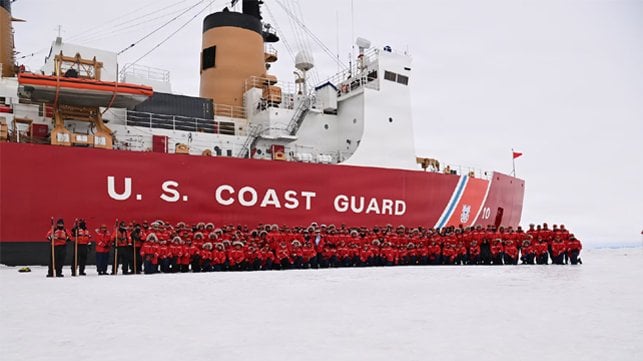
The U.S. Coast Guard Cutter Polar Star returned to her home port of Seattle last week, wrapping up her annual deployment to Antarctica. This year was special, for in addition to supporting the resupply mission and scientific research, the vessel marked 50 years in service. Through extensive overhauls and regular maintenance, she continues to play a critical role as the U.S.’s only heavy icebreaker and must remain active until at least 2030, when the first of the new vessels is now scheduled for delivery.
Polar Star departed Seattle on November 20 and returned to Seattle on April 13. It was a 146-day Antarctic deployment that saw her travel more than 20,000 nautical miles. She makes stops in New Zealand en route, and this year she spent a total of 62 days in Antarctic waters. Polar Star conducted multiple mission sets before departing the Antarctic region on March 8.
One of her key roles is supporting Operation Deep Freeze, the annual resupply missions to the U.S.’s McMurdo Station. This year, she was called on to establish a seven-mile-long channel through fast ice up to eight feet thick and escorted a fuel tanker and container vessel through the ice in McMurdo Sound as part of the resupply mission. Polar Star also escorted a tug with the 330-foot-long NSF Discovery Pier for installation at McMurdo Station in place of the temporary structure and ice pier used in the past. In January, she also undertook an unusual mission to aid a cruise ship that encountered heavy ice floes.
Polar Star also supported the Commission for the Conservation of Antarctic Marine Living Resources (CCAMLR) by completing sighting reports of fishing vessels in the Ross Sea. Through monitoring and documenting fishing activity, the crew helped ensure compliance with established regulations, protecting marine resources and U.S. interests in one of the world’s most remote and scientifically significant regions.
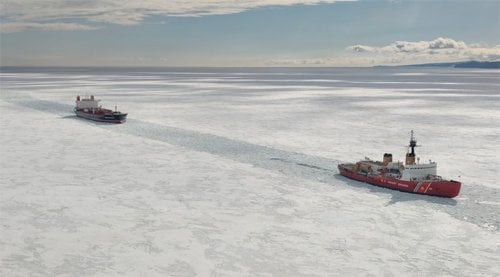
In January, escorting the Stena tanker to reach McMurdo Station (USCG)
“Coming back to Seattle following deployment for the first time in a few years means a lot, especially considering how we spend over 300 days away from homeport each year,” said Capt. Jeff Rasnake, Polar Star’s commanding officer. “So, we’ll enjoy the warm embrace of friends and family for a minute before quickly getting back after the hard work of maintaining this cutter and getting it ready for next year’s mission.”
While transiting home, Polar Star’s crew made port calls in Hobart, Australia, and Wellington, New Zealand. It was her first call in Wellington since December 2021, and during her time, she hosted a series of events and receptions.
“Polar Star reminded us of her age on more than one occasion this deployment, but as always, this crew demonstrated the cutter’s unique capability by working together through each challenge and finding a way to get the job done,” said Capt. Rasnake.
Commissioned on January 17, 1976, Polar Star is the nation’s only active heavy icebreaker. For five decades, the cutter has executed missions ranging from Antarctic resupply and search and rescue to environmental protection and national defense.

that matters most
Get the latest maritime news delivered to your inbox daily.
Polar Star had a sister ship, Polar Sea, that was commissioned two years later. She had also participated in Operation Deep Freeze, but in 2010 suffered a life-ending engine failure. The Coast Guard, however, retains her, and crews have been cannibalizing her for critical components that are no longer manufactured.
Over the past few off-seasons, she underwent an extensive, phased renewal program. Polar Star will be completing her annual dry dock maintenance over the summer, ensuring she is ready for ODF27. The critical work completed during these periods ensures that the U.S. maintains year-round access to Antarctica.