
Canada Commissions its Largest Oceanography Science Vessel
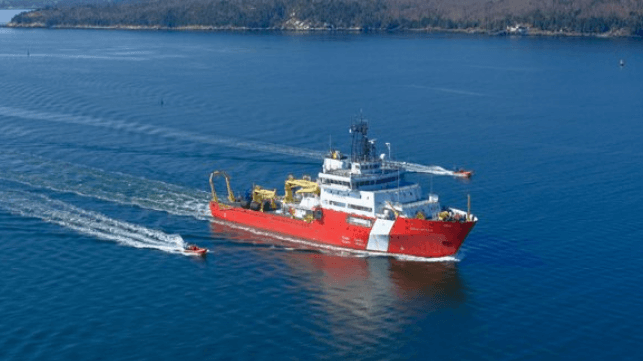
Canada marked what is being called a major milestone both for its National Shipbuilding Strategy and its ocean science capabilities with the christening and official commissioning this week of CCGS Naalak Nappaaluk. The Canadian Coast Guard welcomed the vessel, which became the country’s largest oceanic science research vessel, to its fleet at the Bedford Institute of Oceanography in Dartmouth, Nova Scotia, where she will be homeported.
Constructed at a cost of C$1.4 billion (US$1 billion) at Seaspan’s Vancouver Shipyards, the vessel was completed in November 2025 and has been making her way through the Panama Canal to her home port. Officials emphasized during Tuesday’s christening ceremony that she marks the beginning of the next generation of Canada’s ocean science capability with its cutting-edge marine research facilities that combine with robust operational versatility. Primarily, the 88-meter (289-foot) vessel is designed for supporting important ocean research, conducting critical missions, and improving the country’s understanding of the Atlantic and Arctic Oceans.
Among its key features are a modular working deck that allows for mission-specific science modules to be swapped in and out, an ocean sampling room, multiple specialized laboratories, cranes, towing booms, and seismic compressors for deep-water deployments, and a drop keel and advanced sonar/sensor arrays for detailed ocean-data collection. The vessel is also equipped to support search and rescue missions and environmental response efforts.
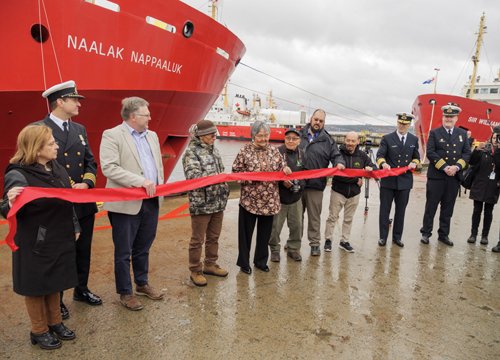
Naming ceremony took place on Tuesday in Nova Scotia (CCG)
Named after Nunavik elder Naalak Nappaaluk (1928-2010), who was known for his vast knowledge of animals, weather patterns, the sea, and the night sky, Naalak Nappaaluk has the capacity to accommodate 34 crew and 26 scientists and boasts a range of over 13,000 nautical miles and an endurance of up to ten weeks at sea. Expected to serve as the primary ocean science platform on Canada’s East Coast for the next 30 years and beyond, Naalak Nappaaluk has replaced the CCGS Hudson, an offshore oceanographic and hydrographic survey vessel that was retired in 2022 after serving for six decades.
The Canadian government highlights that with the Atlantic Ocean being home to some of the richest marine ecosystems in the world, the country’s ability to study and manage the waters is more important than ever, a role that Naalak Nappaaluk is expected to support. Specifically, the data and samples collected onboard are expected to advance the country’s domestic and international commitments to advance the sustainable management of oceans.

that matters most
Get the latest maritime news delivered to your inbox daily.
“In a changing ocean environment, Canada is empowered by advanced technology and the expertise needed to monitor, understand, and respond to ocean challenges. The CCGS Naalak Nappaaluk will enable critical research and science in the Atlantic and Arctic oceans, strengthening our leadership in marine science for decades to come. This is an investment in healthier oceans and the communities that depend on them,” said Joanne Thompson, Minister of Fisheries.
The construction of Naalak Nappaaluk was part of the National Shipbuilding Strategy, a long-term plan by the Canadian government to renew the federal fleet, revitalize the country’s marine industry, and sustain high-skilled jobs nationwide. At the peak of the vessel’s construction, the project employed more than 1,000 workers at Vancouver Shipyards and supported hundreds of suppliers across Canada.