
Barge Defaced at Cargill Terminal in Protests Over Amazon River Dredging
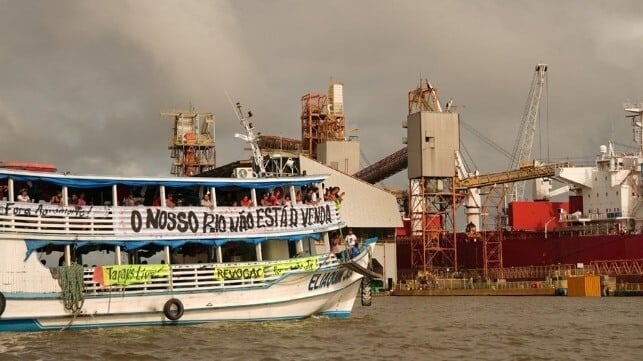
Indigenous protesters and environmental activists in Brazil are showing resolve in their push to stop government projects which they believe will destroy Amazonian rivers and the rainforest, with U.S grain-trading giant Cargill caught in the middle of the controversy.
On February 19, about 400 activists in four boats intercepted a grain barge that was docked at Cargill’s terminal in Santarém. The protesters approached the barge on the urban stretch of the river while it was docked at the terminal, with the police moving in to impede their boats prompting many to jump into the river and managed to board the barge and inscribe the words “The Tapajós River isn’t for sale” and “Revoke the Decree of Death.”
The defacing of the barge, which is part of the soy supply chain operating through the Northern Arc logistics corridor, came on the day when a Brazilian court issued a second order to the government to remove protesters who have been staging a blockade at Cargill’s terminal over the past two weeks.
The indigenous protesters have vowed not to relent in the push to demand the repeal of a decree by the federal government last year that saw the Madeira, Tapajós, and Tocantins Rivers included in Brazil’s National Privatization Program. The protestors are also demanding the immediate annulment of plans to dredge the Tapajós River, which they reckon will have adverse impacts on the Amazonian rivers and the rainforest ecosystem.
According to the protesters - led by non-governmental organization Amazon Watch - the government is using the Tapajós River dredging project as a central piece of a much larger project that is being pushed by agribusiness and global commodity traders, whose aim is to transform Amazonian rivers into industrial export corridors for soy and corn. They argue the project comes when the Northern Arc export corridor is already driving deforestation and eroding socio-biodiversity.
“It is essential to take a critical look at the cumulative impacts of the Northern Arc project. Ferrogrão, the expansion of private grain ports, and the Tapajós waterway together could increase soy volumes by five to seven times, intensifying pressure on traditional territories,” said Renata Utsunomiya, transportation policy analyst at GT Infraestrutura, a coalition of civil society organizations.

that matters most
Get the latest maritime news delivered to your inbox daily.
Utsunomiya added that the consequences of the project go beyond impacts on the Tapajós River because it will likely accelerate deforestation and threaten Brazil’s own climate commitments to reduce forest loss. The project could instigate land speculation and grabbing, soy expansion deeper into the Amazon, water contamination, changes in river flow dynamics and escalating violence along the soy transport routes, Utsunomiya warned.
Brazil remains as the world’s largest soybean exporter with record-breaking shipments in 2025 totaling 109 million tonnes, a 12 percent increase from 2024. China remains the dominant buyer, purchasing nearly 70 percent of the country’s total exports.