
Attack on Tanker Reported off Fujairah After Strikes on Oil Terminal
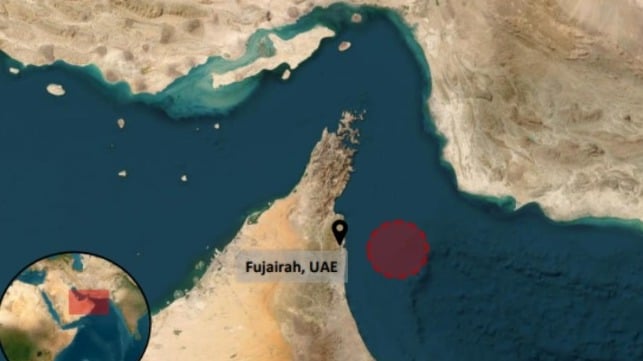
UK Maritime Trade Operations (UKMTO) reports a new attack on a tanker at the anchorage area off Fujairah, a key loading terminal for oil and bunker fuel.
The tanker reported the strike just after 2300 hours GMT on Monday. The unknown projectile caused minor structural damage, UKMTO said, but no injuries to the crew. No pollution has been reported.
It is the latest in a series of attacks on merchant shipping near the Strait of Hormuz, and a reminder that areas well outside of the much-discussed waterway also hold risks for foreign vessels. Iranian strikes have ranged from Kuwait in the north to Salalah, Oman in the south, a sailing distance of more than 1,000 nautical miles.
The attack at Fujairah follows shortly after back-to-back back strikes on the oil loading terminal itself. Imagery posted by bystanders on social media confirmed two large smoke plumes from the Fujairah terminal on March 14, and local authorities confirmed a second, separate drone attack on March 16.
Fujairah is the seaward terminus of the Habshan-Fujairah oil pipeline, one of only two major crude pipelines that can move energy from the Gulf coast to regions outside of the Strait of Hormuz.
"From Tehran’s perspective, this is a deliberate signal: no actor can bypass its influence over the Strait of Hormuz—not even by relying on ports like Fujairah, which are located outside the strait itself. It is therefore likely that Iran will continue to focus on this arena in an effort to disrupt alternative routes for Gulf oil exports that circumvent the strait," commented Danny Citrinowicz, former head of Israeli Defense Intelligence's Iran division and a fellow at Israel's Institute for National Security Studies.

that matters most
Get the latest maritime news delivered to your inbox daily.
The UAE's limited ability to export under current circumstances has pushed its producers to begin to shut in wells, and its crude output is down by half since the start of the conflict, per Reuters. On Monday, an Iranian drone also reportedly hit the Shah gas field in the UAE, one of the only times it has targeted upstream infrastructure directly in this conflict. The field's operations were suspended following the strike.
Overall, as of Monday, an estimated nine million barrels per day of GCC production have been shut in because they have nowhere to go, according to energy analyst Amena Bakr. This amounts to nearly ten percent of daily global demand, and the production slowdown is expected to persist for weeks or months after hostilities end. On the demand side, prices for prompt loadings of Omani oil have soared to $150 per barrel, a sign of tight physical availability and the acute needs of some Asian refiners.