


U.S. Forces and Others Stand by In Case Iran Negotiations Collapse

After the prospect over the weekend of May 23-24 that a negotiated end to the conflict between Iran and the United States was close, signals from both sides suggest that fundamental difficulties remain. These are preventing even an agreement that the present ceasefire should be extended to cover a fixed 60-day period of negotiations on an agreed agenda.
The situation was exacerbated by two waves of U.S. interdictions in the Bandar Abbas area, which forestalled IRGC forces in the act of launching attacks on shipping. In the latest of these, the IRGC fired drones at four ships in the Strait, to which the U.S. Navy responded early on May 28 by targeting a ground control station near Bandar Abbas and intercepting the four IRGC drones that had been launched. A fifth drone was destroyed as it was about to be launched.
From a political perspective:
• IRGC hardliners within the Iranian ruling elite are pushing back against even the very modest concessions that the Iranian negotiating team, led by the Foreign Minister, appeared ready to concede. A number of well-connected Iranian analysts have suggested that these hardliners, headed up by Iran’s virtual Supreme Leader, Mojtaba Khamenei, believe that they are in a dominant position in the negotiations and want to exploit their advantage. As demonstrated by the IRGC attacks that the U.S. Navy interdicted this week, IRGC hardliners appear determined, if necessary, to sabotage even modest compromises that the “moderates” clustered around the Foreign Minister and President Masoud Pezeshkian might be prepared to make.
• President Trump is anxious to settle the war before the forthcoming mid-term elections, but cannot do so politically on terms that are worse than those obtained during the JCPOA negotiations, which concluded in 2015.
• Gulf leaders all desperately need to have the Strait of Hormuz reopened, but to varying degrees, cannot accept restrictions on their future use of the Strait of Hormuz.
• Israel sits on the sidelines, ready to assess whether or not a proposed settlement leaves Iran with capabilities and intentions that pose a continuing threat to its national security – and is prepared to intervene, probably with support from some of the Gulf states – if it judges this to be the case.
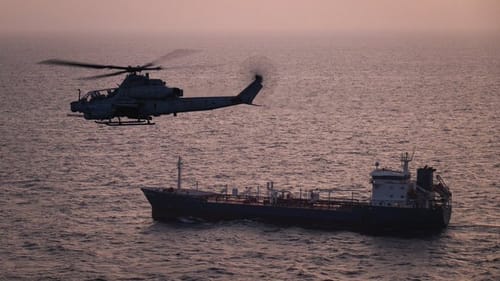
CENTCOM reports as of May 28 that 111 commercial vessels have been redirected (CENTCOM)
When politics fail, leaders resort to military means, and CENTCOM, while maintaining a blockade against Iranian ships and ports, is certainly prepared for a wider resumption of conflict. The main blockade line, including at least one of either the two CENTCOM Nimitz Class aircraft carriers USS George H. W. Bush or USS Abraham Lincoln, holding east of a line between Ras Al Hadd in Oman and the Iran/Pakistan border at Chah Bahar.
Lurking behind cloud cover, the blockade line is thickened up with Arleigh Burke destroyers and assets held further back, including Marines from the 31st MEU, along with F-35Bs aboard the amphibious ships USS Tripoli (LHA 7) and USS New Orleans (LPD-18). These replenish and rotate into forward positions to keep the blockade sustainable in the long term, or as tasks demand. Possibly on the way to the region, but currently off San Diego, is another Amphibious Ready Group led by USS Makin Island (LHD-8), along with USS San Diego (LPD-22) and USS Somerset (LPD-25).
As spotted last month, two Independence Class Littoral Combat Ships are probably posted at either end of the piquet line. This laydown permits the blockade to be maintained without too much vulnerability to short-range IRGC drone and cruise missile attacks, but also enables short-duration forays forward into the Strait, where necessary to intercept blockade runners, and to mount attacks on threatening IRGC activities, as occurred on May 27.
Partial cloud cover over Diego Garcia on May 27 obscured activity at the Naval Support Facility, in the lagoon, and on the airfield, but activity appears unchanged from the norms established over the last few months.
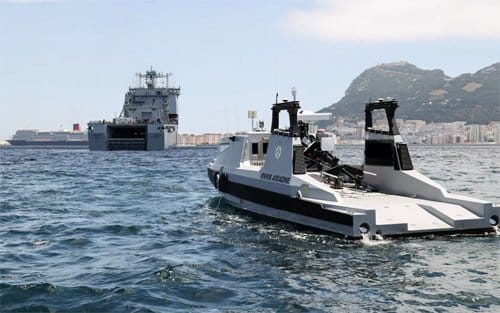
Royal Navy docking its crewless mine-hunting system into mothership RFA Lyme Bay off Gibraltar (Royal Navy)
Moving into the area is a largely European force, ostensibly to police the Strait of Hormuz once the war is over. This force’s most powerful element is the French FS Charles de Gaulle (R91) Carrier Strike Group (CSG) spotted 75nm due east of Mirbat off the Dhofar coast on May 26 by @MT_Anderson, conducting a replenishment with the FS Jacques Chevallier (A725), and probably in company with an Aquitaine-class anti-submarine warfare destroyer that came through the Suez Canal with the flagship.

that matters most
Get the latest maritime news delivered to your inbox daily.
Also, part of the French CSG is the Royal Navy’s air defense destroyer HMS Dragon (D35). RFA Lyme Bay (L3007) with automated mine clearance drones aboard left Gibraltar on May 26 to join up with this force. Additionally en route to Djibouti are two Italian Navy minesweepers, and Germany and Belgium are also planning deployments. All these forces are independent of U.S. operations, but once in the region, their command and control arrangements could be changed as the situation develops, for example, if they were attacked by Iranian forces. Replenishment of this force in the port of Duqm, as might be expected, may be complicated by President Trump’s threat to bomb Oman, where the United States also maintains logistic stocks, which presumably will not be on the targeting list. Several European air forces are also supplementing air defenses in the GCC countries.
The position of the Chinese PLA Navy (PLAN) 48th Naval Escort Group is uncertain at present, but the Type 903A replenishment ship Taihu (K889) was tied up at the PLAN base in Djibouti on May 24, suggesting that the other two vessels of the flotilla, the Type 052DL guided-missile destroyer Tangshan (D122) and Type 054A guided-missile frigate Daqing (Hull 576), are not too far away. The 48th Naval Escort Group has been on station now since November 2026, seven months into a likely ten-month deployment. There are no known Russian Navy vessels in the region, but plenty of Ukrainians are helping to defend the GCC countries from drone and missile attacks.
