


A British Minesweeper That Was Withdrawn From the Gulf is Back on Patrol
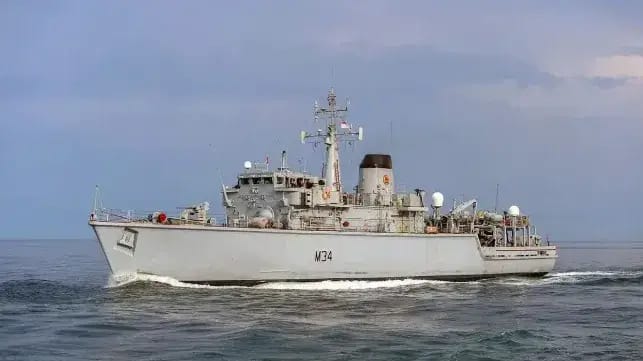
The Hunt Class minesweeper HMS Middleton (M34) was withdrawn from Bahrain just before the outbreak of fighting in the Gulf on February 28. HMS Middleton (M34) provided the last of a unique minesweeping capability alongside the US Navy’s Avenger Class minesweepers, which were also withdrawn from Bahrain at about the same time. This left both navies relying on remote or airborne mine clearing capability, before such capability had been fully brought into service - a gap felt keenly now that the Strait of Hormuz is effectively closed to free transit.
HMS Middleton was brought back to the UK from Bahrain on board the semi-submersible heavy lift vessel MV Rolldock Storm (IMO 9656503), and was refloated in Southampton in early March.
Her sister ship HMS Chiddingfold (M37) returned to the UK by the same means at the same time last year, and in between HMS Bangor (M109) was also brought back from Bahrain. This left the Bahrain-based 9th Mine Countermeasures Squadron bereft of ships.
The general assumption was that the ships of the 9th Mine Countermeasures Squadron were being taken out of service, prompted by the collision between HMS Chiddingfold and HMS Bangor in Bahrain in January 2024, and also by the understanding that HMS Middleton was no longer certified for sea service.
A different, and happier story is now emerging. HMS Bangor has entered a refit which once complete will see her in service for a further five years. Moreover, HMS Middleton has completed a short maintenance period in Portsmouth and at the beginning of May started a deployment up the East Coast of England, and around Scotland, patrolling past Scarborough, Whitby, Sunderland, the Northumberland coast, Scapa Flow, the Isle of Sky and the Isle of Man, very much operational and exercising the mine clearance divers aboard. HMS Chiddingfold is also still in commission too, on extended readiness and now with HMS Middleton as part of the Portsmouth-based 2nd Mine Countermeasures Squadron.
At a time when the older Type 23 frigates are reaching the end of their service lives, and before the arrival of the first Type 23 and 31 frigates currently being fitted out, having ships of the 2nd Mine Countermeasures Squadron available will assist with filling gaps at a time when the Royal Navy is facing increased need to patrol home waters to shadow Russian ship movements – either from the much-depleted Russian Navy or the Russian tanker dark fleet. The multi-crewing of ships in the squadron also assists in improving vessel availability for short-notice tasks.

that matters most
Get the latest maritime news delivered to your inbox daily.
Intercepting sanctioned Russian-owned dark fleet tankers is still clearly presenting the Royal Navy with challenges. Whilst theoretically having the necessary legal framework in place to carry out interceptions, when vessels are either unseaworthy or false-flagged, the Royal Navy for the moment has been confined to a supporting role for French naval action, it being unclear whether this is for legal reasons or because of a shortage of necessary naval vessels which would be needed to intercept and escort targeted Russian dark fleet tankers.
The last enforcement action in the maritime sector initiated by the United Kingdom’s Office of Financial Sanctions Implementation was a $6,750 penalty imposed on Svarog Shipping & Trading Company Limited in May 2025, a fine which is unlikely to have given the managers of the Russian dark fleet too much cause for concern.
